Product Fruits vs Userflow: which onboarding platform should you choose in 2026?


Most "vs" articles compare feature checkboxes and call it a day. That is not how a real buying decision works. By the time you are weighing Product Fruits against Userflow, you already know both build tours, checklists, and surveys without code. The question that actually decides your renewal in year two is different: which one gets your team to value faster, keeps costs predictable as you grow, and turns onboarding into something that runs itself instead of something you babysit.
This is a practitioner's comparison. We will look at how each tool is built, what its AI actually does, how you get at your own data, what you pay at real MAU counts, and where each one is genuinely the better call. No strawmen. Userflow is a good product. The goal is to help you pick the right one.
TL;DR
- Product Fruits is an independent, AI-first product adoption platform. It pairs a branching Flows canvas, the Elvin AI assistant, a native knowledge base, and transparent MAU-based pricing that starts around $111 a month. Best for teams that want onboarding, in-app messaging, feedback, and self-serve support to work as one system.
- Userflow is a clean, fast, well-loved onboarding builder, now part of Beamer after a 2024 acquisition. Its 2026 pricing splits into two separately-billed products: Adoption Studio for onboarding (from $400 a month annual for 1,000 MAUs) and a credit-metered Adoption Agent for AI. Best for teams that want tidy checklists and resource centers and little else.
- The three deciding gaps in 2026 are analytics access, AI depth, and orchestration. Userflow users most often complain about limited reporting and generic AI. While both have now MCP connector for LLM analysis of onboarding data, Product Fruits adds Annotations and Discoveries that make its AI concrete rather than decorative.
- There is no universal winner. Pick Userflow for simple, checklist-led onboarding. Pick Product Fruits when you want an adoption system that adapts, deflects tickets, and scales without a "contact sales" wall.
Product Fruits vs Userflow at a glance
Here is the shape of the decision before we get into the why.
Both tools clear the table stakes: tours, tooltips, checklists, banners, NPS, segmentation, and the usual integrations. The differences show up one layer down.
How each tool is built: linear flows vs a branching canvas
Userflow's core strength is its authoring experience. Reviewers consistently call it easy to learn and quick to ship, and that is real. If your onboarding is a linear sequence of steps and a checklist that points people to a resource center, Userflow gets you there fast and cleanly. It is one of the most pleasant flow builders on the market.
The ceiling shows up when onboarding needs to react. Userflow flows are largely linear. Product Fruits Flows are built on a visual canvas where the path branches. A Flow is a sequence of cards, conditions, actions, and messages that only advances when the user does the expected thing. You branch on user properties, read and write those properties mid-experience, wait for real behavior, call an external API to pull in data, and trigger actions like posting to Slack or firing an email, all without a developer.
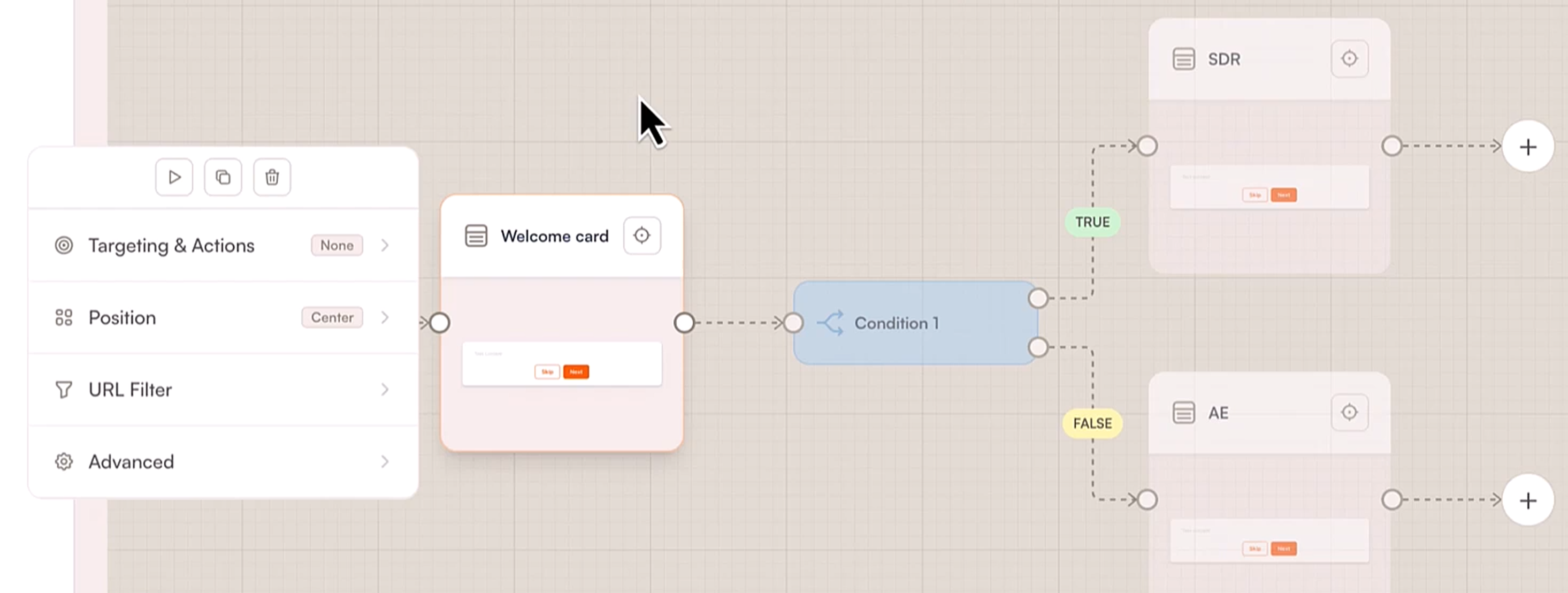
That difference compounds. A linear tool makes you build a separate flow for every persona and every branch, then maintain all of them. A branching canvas lets one Flow adapt to plan type, role, or behavior in real time. Teams use it to run an entire feature-release process, or fully self-service beta enrollment, from a single workflow. This is the gap between owning onboarding as a pile of separate experiences and running it as one connected system.
AI: included and operational versus separate and metered
This is where the two tools diverge most, and it is worth being precise because "AI" is packaged very differently here.
Userflow's approach in 2026 is to split AI into two places. FlowAI (Builder, Signals, Actions) ships inside the Adoption Studio and helps you draft and analyze flows. The user-facing AI agent that answers your customers is a separate product, Adoption Agent, billed on its own and metered in credits, where one credit covers two AI messages. So the AI that actually deflects support is a second subscription that scales with usage. And the common complaint about FlowAI's draft output is that it comes out generic and loses the specificity teams need. It helps you start. It is not included with your onboarding plan the way you might expect.
Product Fruits builds its AI around a concrete job: deflecting support and generating guidance on demand. The Elvin AI assistant answers users' how-to questions in real time from your knowledge base and docs, and when it truly cannot help, it drafts a structured handoff so a human starts with full context. Customers report real numbers here. Mystore routes support through Elvin first and resolves 50-90% of inquiries autonomously. Adeus stood up its assistant in about an hour and handles roughly 60% of queries end to end.
Two 2026 additions make that AI sharper. Annotations let an admin walk their app with a Chrome extension, click on UI elements, and build a tree that teaches Elvin how the product actually works. That is what lets Elvin generate interactive guides on the fly, even before you have written a full knowledge base. It is the fastest way to hand product knowledge to an AI. The result is guidance that reflects your real interface, not a generic script.
In-app research: static surveys vs Discoveries
Both tools do surveys and NPS. If you want a fixed set of questions in front of users, either works.
The interesting shift is Discoveries, Product Fruits' LLM-powered successor to the survey. Instead of asking everyone the same predetermined questions, you describe what you want to learn, and Elvin runs a short conversational interview inside your product. It asks contextual follow-up questions based on each person's answers, digging into the "why" the way a researcher would. Then it synthesizes the responses into an insight report automatically.
The practical win is depth without the manual load. A traditional survey tells you 40% of users are unhappy with a feature. A Discovery tells you why, in the user's own words, across dozens of adaptive conversations you never had to moderate. For a growth or product team trying to understand activation drop-off or churn signals, that is a different class of insight. Userflow's surveys are perfectly serviceable for a quick pulse check. They do not do this.
Analytics and data access: Most cited gap for both
Ask Userflow customers what they wish were better and the answer is remarkably consistent: analytics and reporting. It is the most frequent complaint in 2026 reviews. Users note they cannot report the way they want, and that cohort-level analysis is thin. Session recording and heatmaps are not there. For teams that make decisions from data, that is a real constraint.
Product Fruits ships built-in flow analytics, completion rates, paths, and tour performance, which cover most onboarding optimization. New discoveries are a strong conversational analytics tool, providing ai-executed interviews with individual users as basis for deeper product and user analysis. Both platforms also ofer MCP (Model Context Protocol), a connector that lets an LLM like Claude or ChatGPT read your Product Fruits data directly. You ask, in plain English, where users drop off in a flow, or to summarize what customers said in recent Elvin conversations, or which onboarding content is underperforming, and the assistant answers from live data.
That reframes the analytics conversation entirely. Instead of buying a heavier tool to get better dashboards, you let AI survey your users or point the AI you already use at the data you already have. Both platform have improved recently but we believe Product Fruits have slight edge with discoveries.
Knowledge base and self-serve support
Userflow offers a resource center: a tidy launcher that surfaces links and content. It is good at what it does. What it is not is a true knowledge base.
Product Fruits includes a native, white-labeled knowledge base and help center, and it is wired directly into Elvin. Your help articles become answers the AI can serve inside the app, in the user's language, with auto-translations handling the localization. Outsmart used this to unify in-app support, connect its feedback widget to Jira, localize help into four languages, and lift resolved tickets by 26%. The support surface and the knowledge that powers it live in one place, so self-serve deflection is a built-in outcome rather than a bolt-on.
If self-serve support is part of why you are buying an onboarding tool, this is a meaningful structural difference. With Userflow you are likely pairing it with a separate help-desk or knowledge tool. With Product Fruits the knowledge base, the AI, and the in-app help widget are the same system.
Pricing: what you actually pay as you grow
Both tools price on monthly active users, and both are transparent enough to compare honestly. Userflow overhauled its packaging in 2026, so the older Startup and Pro tiers are now legacy. Here is the current shape.
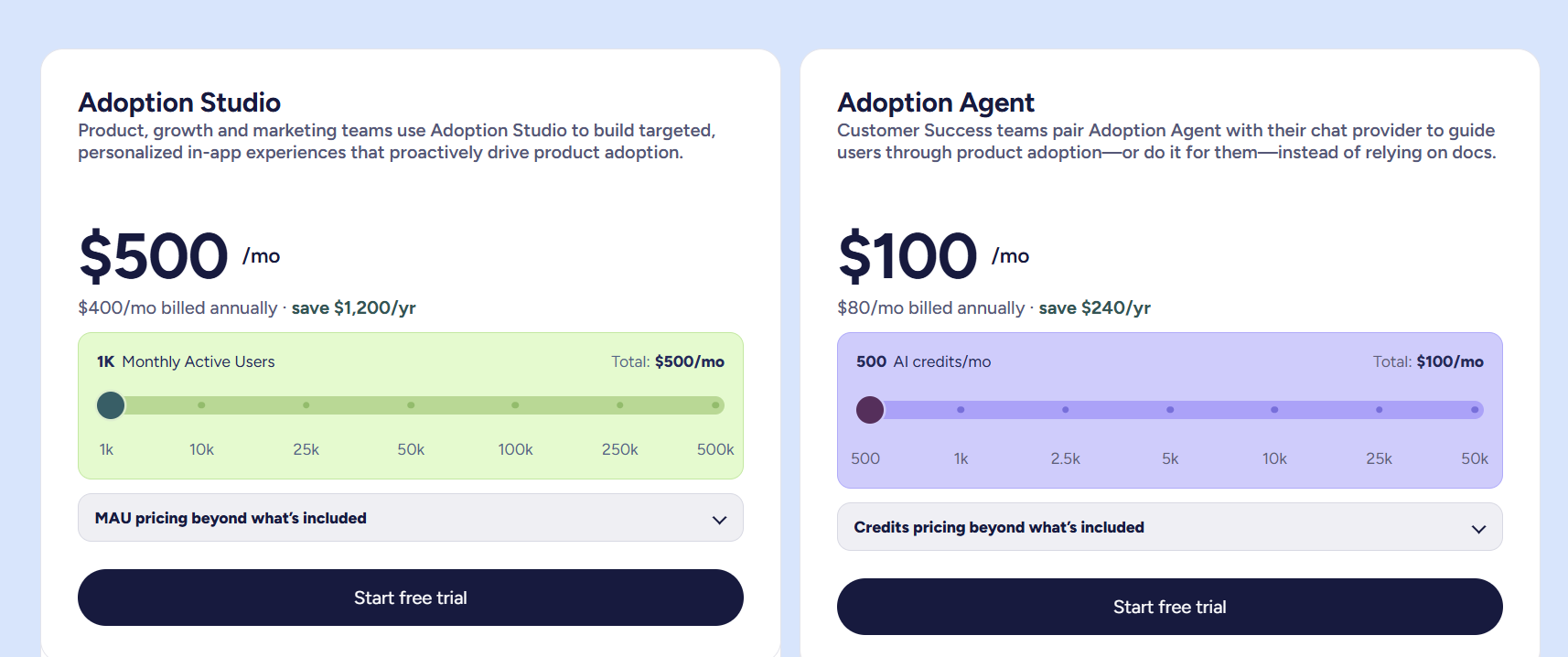
Userflow now sells two separate products. Adoption Studio, the onboarding platform, starts at $400 a month billed annually ($500 monthly) and includes 1,000 MAUs, then scales at $30 per additional 1,000 MAUs up to 10,000. At 10,000 MAUs that is roughly $670 a month for onboarding alone. The AI that answers your users, Adoption Agent, is a second subscription at $80 a month annually ($100 monthly) for 500 credits, where one credit covers two AI messages, with more credits at $20 per 100. Seats are unlimited on both, which is a genuine plus.
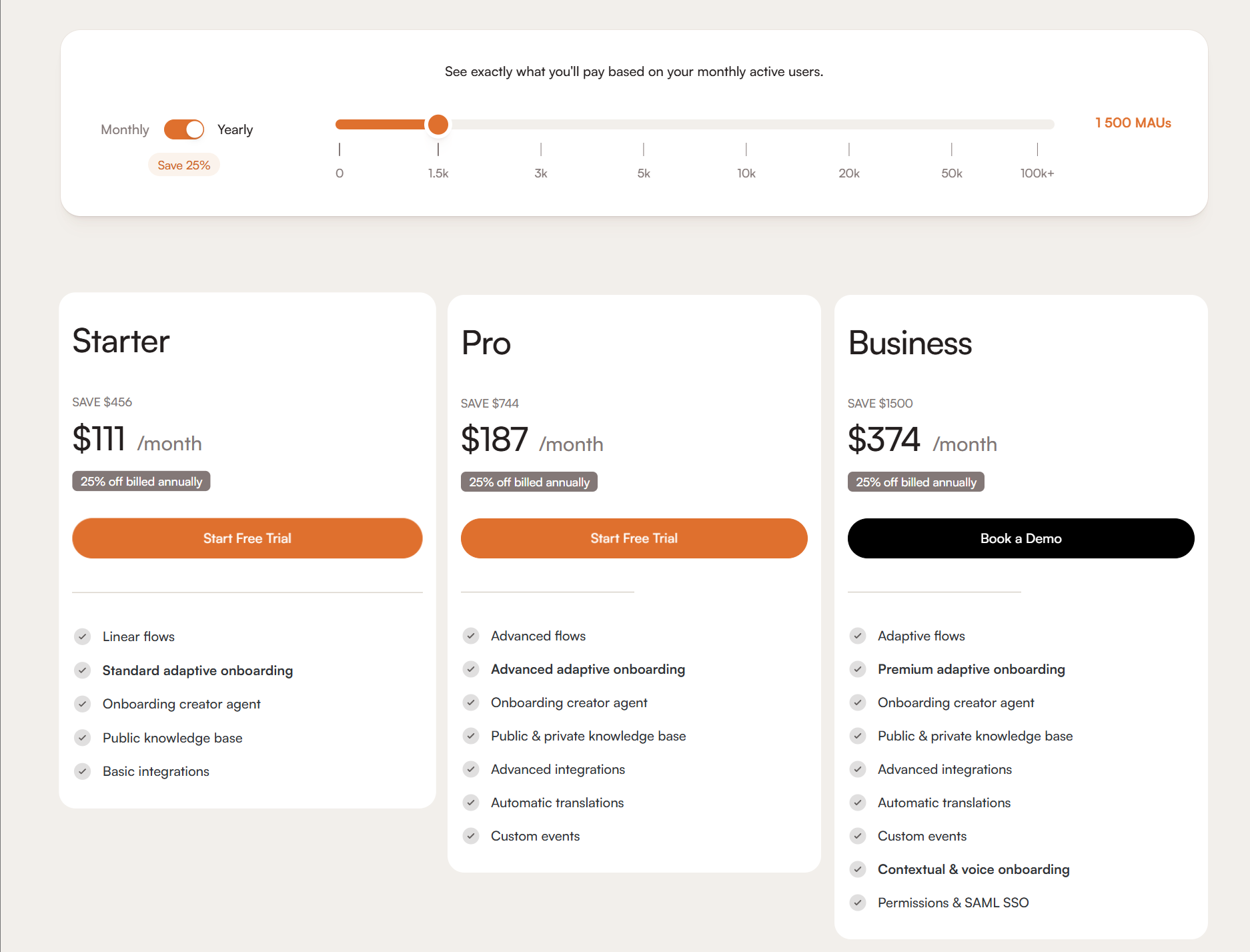
Product Fruits uses a transparent pricing slider you can read without a sales call. Published plans start around $111 a month with Elvin AI included not billed separately ($187 gets you complete set of features with on demand guides and discoveries). At 10,000 MAUs you are typically in the $339 to $499 a month range, still with AI in the plan.
The headline is not "cheaper." It is packaging. With Product Fruits, onboarding and the AI that deflects support are one plan. With Userflow in 2026, they are two products with two invoices.
The Beamer question: roadmap and ownership
This one is easy to overlook and important for a multi-year decision. Userflow was acquired by Beamer in early 2024 in a deal valued at more than $60 million, and it now sits inside Beamer's broader product engagement suite. The onboarding builder is still very much alive, so this is not a reason to rule Userflow out. But it changes the calculus.
When a focused product becomes one line in a suite, roadmap priorities, pricing, and support attention are set at the suite level, not the product level. If onboarding is the core of what you need, you want to know that the team building it is pointed squarely at onboarding. Product Fruits is independent and onboarding-first, and its 2026 releases, Flows, Annotations, Discoveries, and MCP, show a roadmap moving fast in exactly that direction. For a tool you plan to build critical activation flows on, continuity of focus is a real factor, not a footnote.
What real users say: ratings and reviews
Both tools are well-liked, and it is worth being straight about the scores. On raw averages, Userflow edges ahead. On depth of validation, Product Fruits pulls in front. Here is the current picture.
The read on this is nuanced. Userflow's averages are a touch higher, and that reflects a genuinely polished product that people enjoy using. But those scores sit on a smaller base, 14 Capterra reviews versus 89, and Userflow has no meaningful Gartner Peer Insights presence, while Product Fruits carries a rating across all three, including the analyst-grade Gartner listing. More reviews across more platforms is a stronger signal than a slightly higher average on fewer.
What is more telling is what reviewers actually say, because it maps almost exactly onto the differences above.
On the Product Fruits side, the recurring themes are fast setup, support, and AI that pays off. "Elvin is a game changer for us, currently about 50% of our support chats are resolved by Elvin," writes Trond-Daniel K., a Product Manager, on G2. Jennifer H., a Solution Services Manager, adds: "It's designed with the end-user in mind. It is so intuitive to implement and use. Amazing customer service, AI features." On Capterra, Ignacio A., a Product Manager, notes the tours have "an intuitive interface... and almost no implementation is needed," while Anya A. highlights value: "I love the ability to add multiple domains for the same price." The fair criticism to note: some reviewers want deeper design customization and richer native analytics.
On the Userflow side, the praise is consistent and real: it is easy, fast, and handles complex UIs well. "The product is extremely powerful. It's the only one I've found that can handle complex UIs smoothly," writes Quentin D., a Head of Growth, on Capterra. But the criticisms line up precisely with this article's analysis. On analytics, Karine D., a Product Owner, writes on G2: "We can't report on Analytics. It would be very nice to have more reporting capability." On AI quality, James G. reports that "AI flow creation proved to be a little too automated and lost some specificity that we required." And on the split-out AI pricing, Trevor L. is blunt: "Userflow's pricing is expensive for small companies. Most notably, the AI Assistant can get pricey fast if your users actually use the chat."
That last quote is the whole pricing section in one line, from a Userflow customer. When users lean on the AI, the metered Adoption Agent bill climbs. With Product Fruits, Elvin is in the plan.
Which should you choose?
Choose Userflow if your onboarding is fundamentally simple: linear flows, clean checklists, a resource center, and a fast, pleasant builder your team can pick up in a day. If you do not need analytics (beyond basics and MCP), a true knowledge base, or AI that runs support, and you are comfortable inside the Beamer ecosystem, it is a solid, well-built choice.
Choose Product Fruits if you want onboarding to behave like a system that adapts. If you need branching Flows without engineering, AI that actually deflects tickets, a native knowledge base, adaptive research through Discoveries, and the ability to query your own data with an LLM through MCP, all at transparent pricing that does not spike between tiers, it is the stronger fit. It is especially compelling for teams under 25,000 MAUs who want enterprise-grade capability without an enterprise contract.
The honest summary: Userflow is the cleaner tool for simple onboarding. Product Fruits is the more capable platform when onboarding, support, and feedback need to work together.
FAQ
Is Product Fruits a good Userflow alternative?
Yes, and it is one of the closest feature-for-feature matches with more included. Product Fruits covers the same core (tours, checklists, surveys, segmentation) and adds a branching Flows canvas, the Elvin AI support assistant, a native knowledge base, and an MCP connector for analyzing your data with an LLM. It is independent and onboarding-first, with transparent pricing that starts around $187 a month.
How much does Userflow cost in 2026?
Userflow now sells two products. Adoption Studio (onboarding) starts at $400 a month billed annually ($500 monthly) for 1,000 MAUs, scaling at $30 per additional 1,000 MAUs, so around $670 a month at 10,000 MAUs. Adoption Agent (the user-facing AI) is separate at $80 a month annually for 500 credits, where one credit covers two AI messages. Seats are unlimited on both. The older Startup and Pro plans are now legacy.
What is the main difference between Product Fruits and Userflow?
The biggest differences are AI depth, analytics access, and orchestration. Userflow is a clean, linear onboarding builder whose users often cite limited reporting and generic AI. Product Fruits adds a branching Flows canvas, an AI assistant that resolves support autonomously, adaptive Discoveries research, a native knowledge base, and MCP access to your data, so onboarding, feedback, and support run as one connected system.
Does Userflow have a knowledge base?
Not a full one. Userflow offers a resource center that surfaces links and content in-app, which is useful but not a true knowledge base. Product Fruits includes a native, white-labeled knowledge base wired directly into its Elvin AI assistant, so your help articles become answers the AI serves inside your product, with automatic translations.
Is Userflow still independent?
No. Beamer acquired Userflow in early 2024 in a deal valued at more than $60 million, and it now sits within Beamer's product engagement suite. The onboarding builder remains active, but roadmap and pricing decisions are made at the suite level. Product Fruits, by contrast, is independent and focused specifically on onboarding and product adoption.
Can I analyze my onboarding data with AI in Product Fruits?
Yes. Product Fruits offers an MCP (Model Context Protocol) connection that lets LLMs like Claude or ChatGPT read your data directly. You can ask in plain English where users drop off, summarize Elvin support conversations, or find underperforming onboarding content. Access is read-only and scoped to your account permissions. Userflow does not offer an equivalent LLM data connector.
Is Product Fruits or Userflow better rated?
They are close. Userflow's averages are marginally higher (4.8 on G2 and Capterra) but rest on fewer reviews, including just 14 on Capterra. Product Fruits sits at 4.6 to 4.7 across G2, Capterra, and Gartner Peer Insights, on a broader base of 240-plus G2 reviews and an analyst-grade Gartner listing that Userflow lacks. Both are strong; Product Fruits has wider third-party validation.
The bottom line
Choosing between Product Fruits and Userflow is not about who has tours and checklists, because both do. It is about what happens after the demo, when your team is building real activation flows, fielding support tickets, and trying to understand why users churn. Userflow is a clean, capable tool for simple, checklist-led onboarding. Product Fruits is the better choice when you want onboarding that adapts, AI that deflects real support load, research that digs deeper than a survey, and full access to your own data, at pricing that stays predictable as you grow. Want to see how Flows, Elvin, and Discoveries would work on your product and MAU count? Try Product Fruits for free or Book a demo.


Weekly newsletter
Get the latest releases, tips, articles, and exclusive interviews delivered to your inbox weekly—no spam!