SaaS Tools for Product Led Growth: Complete 2025 Guide


Product-led growth means the product itself drives customer acquisition, activation, and expansion. Users experience value before paying. The product sells itself through excellence. This approach requires specific tools that traditional sales-led companies don't need.
SaaS tools for product-led growth fall into five essential categories:
- user onboarding platforms like Product Fruits that guide users to activation
- analytics tools that track product usage
- communication platforms for in-app messaging
- feedback systems for gathering user insights
- and integration tools that connect product data across systems.
Product Fruits stands out by combining AI-powered onboarding with behavioral analytics, achieving 64% user activation rates that enable self-serve growth without sales intervention.
TLDR:
PLG relies on your product—not sales—to drive acquisition, activation, and expansion. The core tool stack spans onboarding/adoption, analytics, in-app communication, feedback, and integrations. If activation is weak, start with AI-powered onboarding (e.g., Product Fruits). Track activation, time-to-value, retention, and expansion. Scale your stack as you move from early to enterprise.
What Is Product-Led Growth?
Product-led growth (PLG) is a business methodology where the product serves as the primary driver of customer acquisition, conversion, and expansion. Users try the product through free trials or freemium access, experience value firsthand, and convert to paid customers based on product excellence rather than sales persuasion.
Core PLG principles:
- Users can start using the product immediately with minimal friction
- Value becomes evident quickly through product experience
- The product educates users through usage rather than training
- Expansion happens through increased product engagement
- Users become advocates who refer others
Companies like Slack, Dropbox, Zoom, and Figma exemplify product-led growth. Users adopt these products organically because the products solve problems elegantly.
What SaaS tools focus on Product Led Growth?
Traditional B2B SaaS relies on sales teams to guide prospects through adoption. Sales reps demo features, answer questions, and ensure customers succeed. This high-touch model scales linearly with headcount.
Product-led growth inverts this model. The product must handle what sales reps previously did. Users need to understand features without demos. Questions need answers without sales calls. Success needs to happen without customer success managers.
This self-serve model requires tools that:
- Guide users through products without human intervention
- Provide instant answers to questions
- Track which users engage deeply and might expand
- Identify struggle points before users churn
- Enable expansion through product usage patterns
Traditional marketing and sales tools don't address these needs. PLG requires product-specific tooling.
Category 1: User Onboarding and Adoption Tools
User onboarding directly impacts PLG success. Users who reach their first win quickly convert to paid customers. Users who get confused churn before seeing value.
Product Fruits
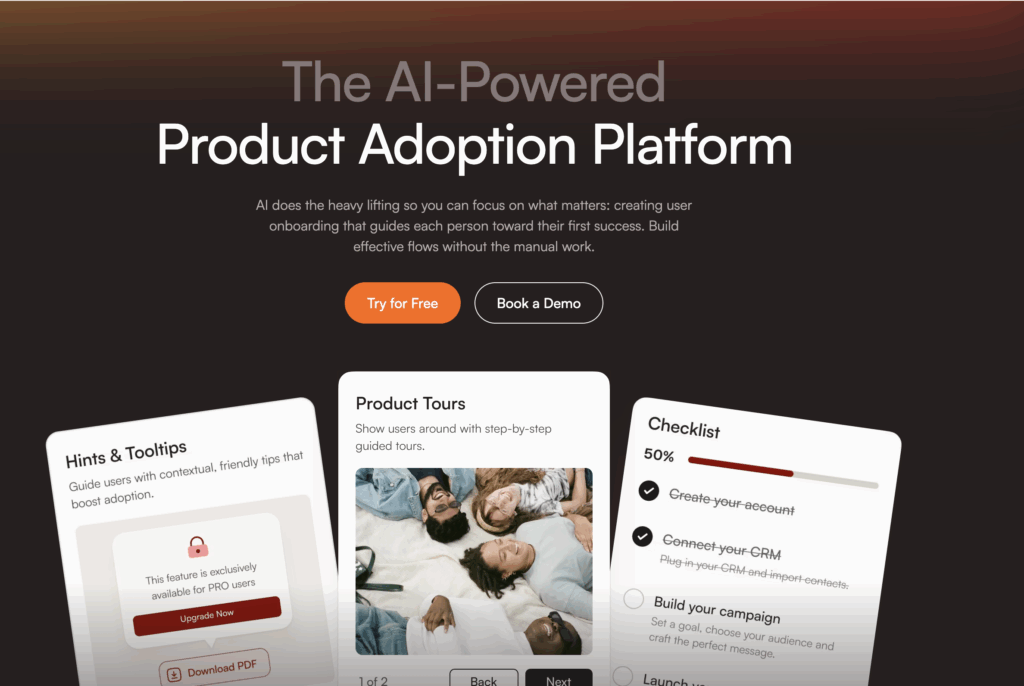
Product Fruits uses Elvin AI to automate user onboarding for product-led companies. Instead of requiring sales demos or training sessions, the product guides users to activation automatically through personalized experiences.
PLG capabilities:
- AI-generated onboarding that adapts to each user without manual building
- Elvin Copilot provides instant answers without support tickets
- Onboarding checklists guide users through activation milestones
- Behavioral triggers surface relevant features based on usage
- In-app announcements communicate updates without email
- Knowledge base enables self-service help
Why it enables PLG: Users activate without human intervention. The AI personalizes experiences at scale. Support questions get answered instantly. This removes friction from self-serve adoption.
PLG results: 64% average activation rate versus 25% SaaS standard baseline. Keboola accelerated onboarding by 29%. FitnessPlayer reduced churn by 70% through better self-serve adoption.
Pricing: Starts at $96 monthly for full platform with AI features.
Appcues
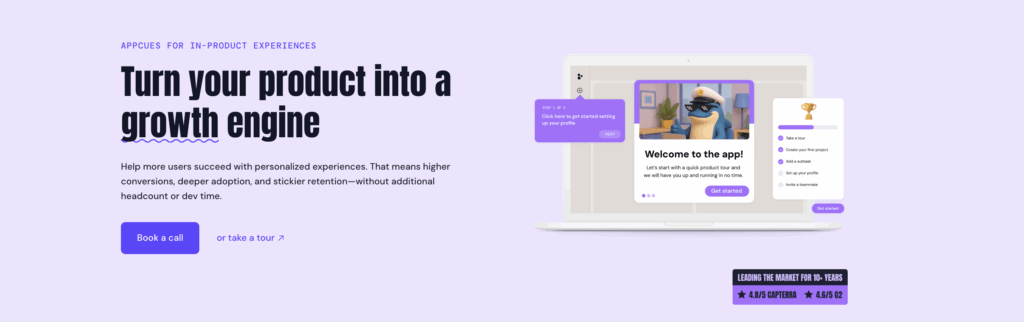
Appcues provides no-code tools for building product tours, tooltips, and surveys. Product teams create onboarding experiences without engineering resources.
PLG capabilities:
- Visual builder for product tours
- User segmentation for targeted experiences
- Mobile SDKs for native apps
- A/B testing for optimization
- NPS surveys for feedback
Why it enables PLG: Non-technical teams can iterate on onboarding quickly. No waiting for engineering sprints.
Limitations: Requires manual tour building. No AI personalization. Premium pricing at scale.
Pricing: Starts at $300 monthly.
Userpilot
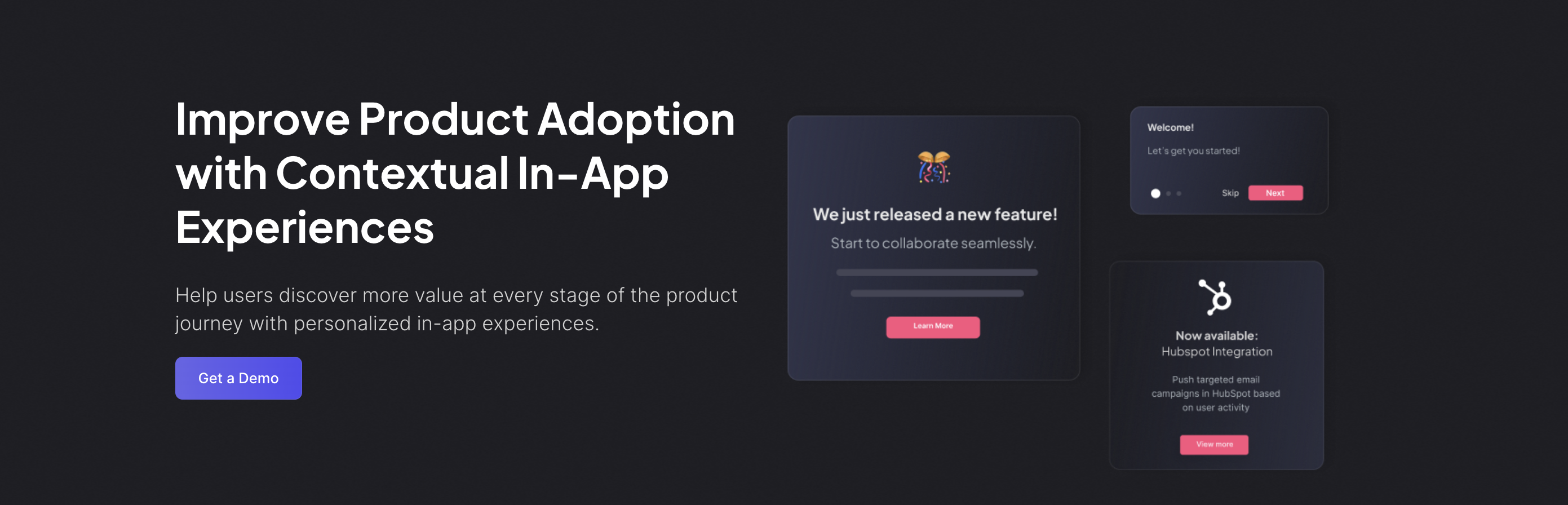
Userpilot combines onboarding tools with product analytics. Teams see where users struggle and build interventions at those points.
PLG capabilities:
- Product tours and checklists
- Event tracking without code
- User segmentation
- In-app surveys
- Analytics dashboard
Why it enables PLG: Data-driven onboarding decisions. See drop-off points and address them.
Limitations: Complex interface. Higher price point. No AI capabilities.
Pricing: Starts at $249 monthly.
Category 2: Product Analytics Tools
PLG companies need deep visibility into product usage. Which features drive retention? Where do users struggle? Who is ready to expand? Analytics tools answer these questions.
Mixpanel
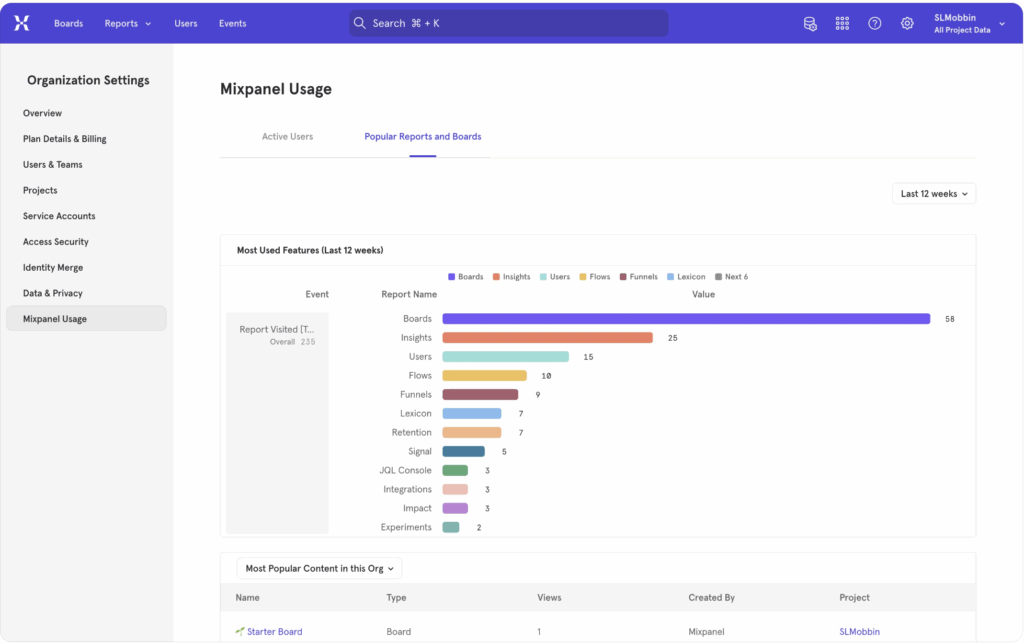
Mixpanel tracks user behavior and product engagement. Teams understand exactly how users interact with products.
PLG capabilities:
- Event-based analytics tracking every user action
- Funnel analysis showing conversion through key flows
- Retention cohort analysis
- User segmentation
- A/B testing analysis
Why it enables PLG: Data reveals what drives activation and retention. Product improvements target actual usage patterns rather than assumptions.
Pricing: Free tier available. Paid plans start at $20 monthly, scaling with event volume.
Amplitude
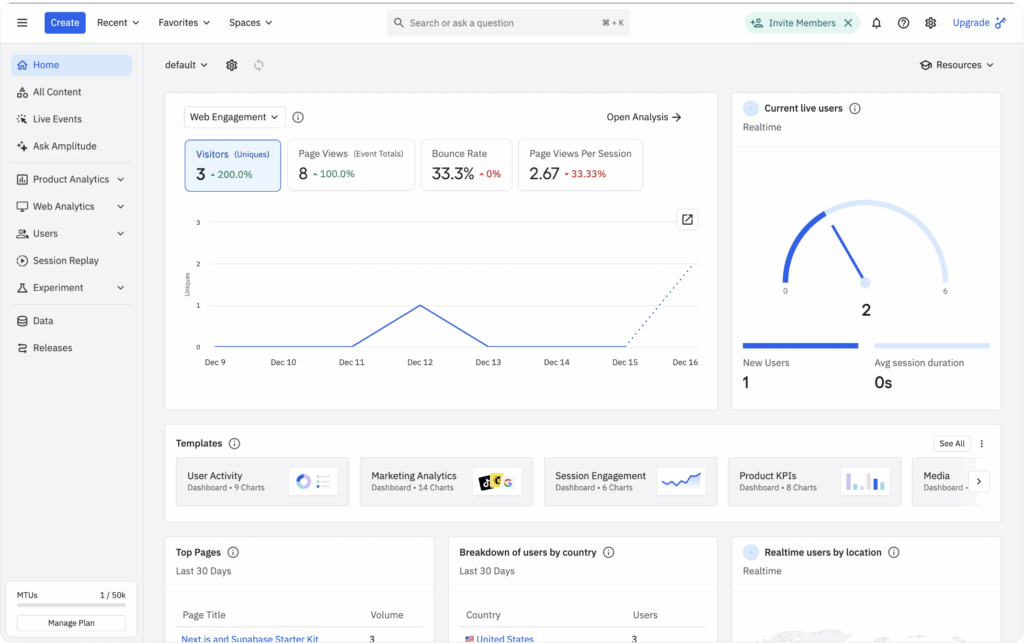
Amplitude provides product analytics focused on user journeys and behavioral cohorts. The platform emphasizes understanding paths users take through products.
PLG capabilities:
- User journey mapping
- Behavioral cohorts
- Retention analysis
- Predictive analytics
- Experimentation platform
Why it enables PLG: Understanding user paths reveals optimization opportunities. Predictive analytics identify expansion candidates.
Pricing: Free tier for up to 10M events monthly. Growth plans scale with usage.
Heap
Heap automatically captures all user interactions without requiring event instrumentation. This retroactive analytics capability lets teams analyze past behavior without prior setup.
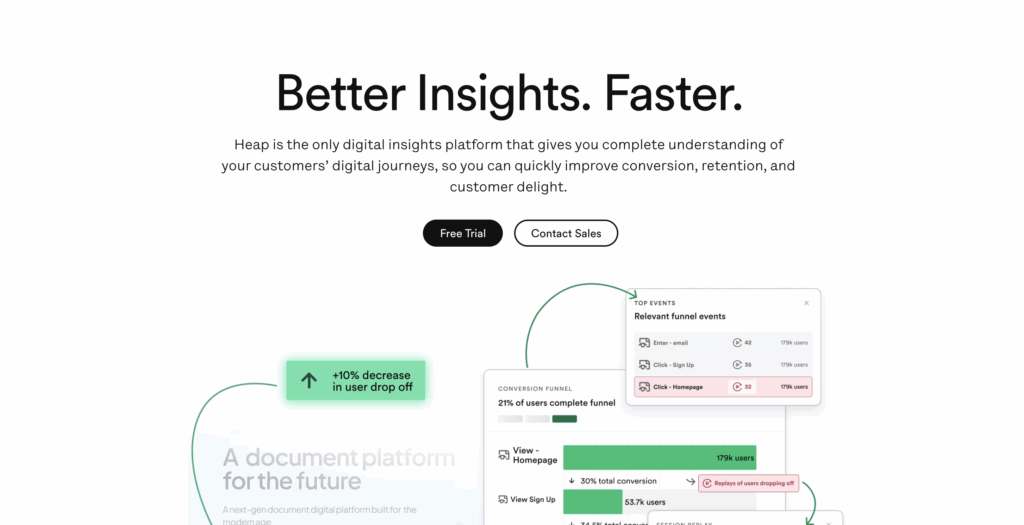
PLG capabilities:
- Automatic event capture
- Retroactive analysis
- Session replay
- Funnel analysis
- User segmentation
Why it enables PLG: No instrumentation means faster insights. Teams can analyze historical behavior patterns to understand what drives success.
Pricing: Custom pricing based on data volume.
Category 3: In-App Communication Tools
PLG requires communicating with users inside products rather than through email. In-app messages reach users at relevant moments with higher engagement.
Intercom
Intercom provides in-app messaging, chat, and support tools. Users get help without leaving products.
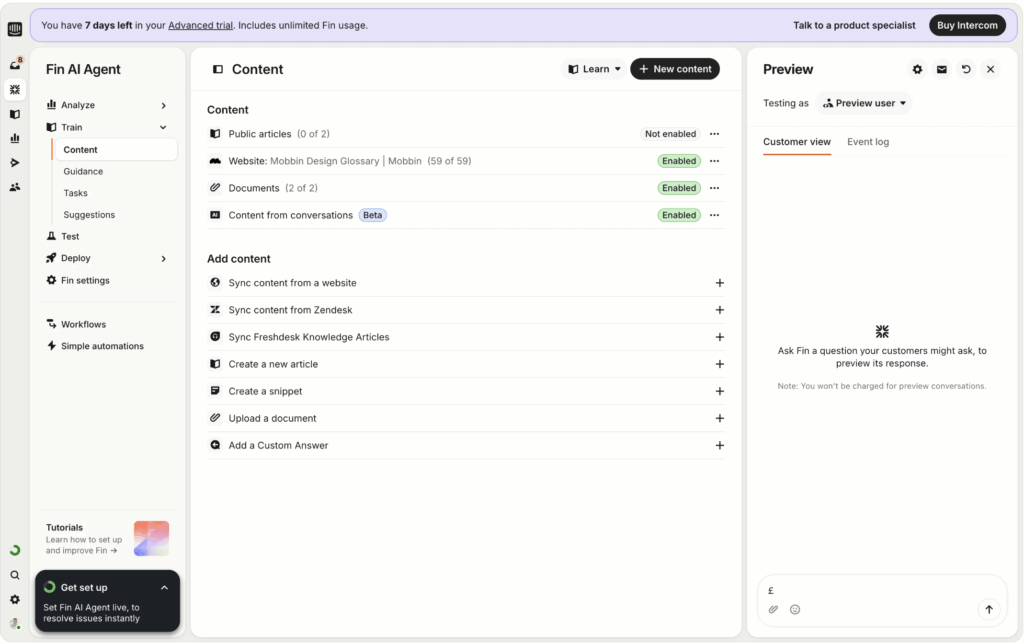
PLG capabilities:
- In-app chat for instant support
- Targeted messaging based on behavior
- Product tours (basic)
- Help center integration
- Chatbot automation
Why it enables PLG: Real-time support enables self-serve users. Contextual messages guide users to relevant features.
Pricing: Starts at $39 per seat monthly.
Pendo
Pendo combines analytics with in-app guidance. Teams see usage data and create interventions in one platform.
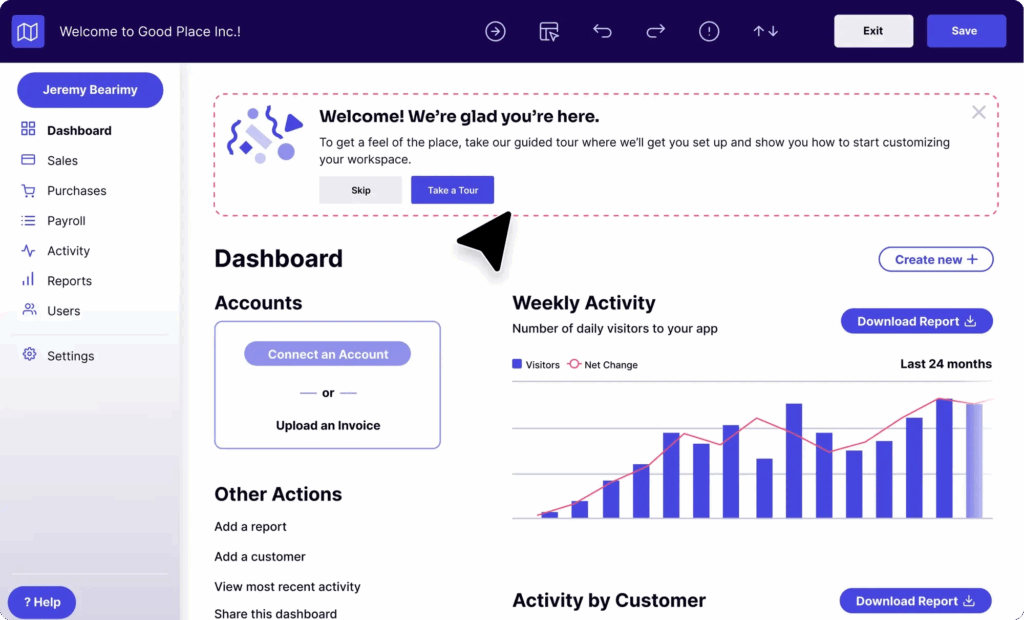
PLG capabilities:
- Product analytics
- In-app guides and tours
- Resource center
- User segmentation
- Feedback collection
Why it enables PLG: Single platform for insights and action. Data directly informs guidance.
Pricing: Custom enterprise pricing, typically $20,000+ annually.
Category 4: Customer Feedback Tools
PLG companies need to understand what users want without extensive customer interviews. In-product feedback collection scales insights.
Typeform
Typeform creates conversational surveys that feel natural rather than tedious. Higher completion rates provide better insights.

PLG capabilities:
- Conversational survey format
- Conditional logic for personalization
- Integration with most tools
- Response analysis
Why it enables PLG: Quality feedback at scale. Understand user needs without sales calls.
Pricing: Free tier available. Paid plans start at $25 monthly.
Hotjar
Hotjar provides heatmaps, session recordings, and surveys. Visual data reveals how users actually interact with products.
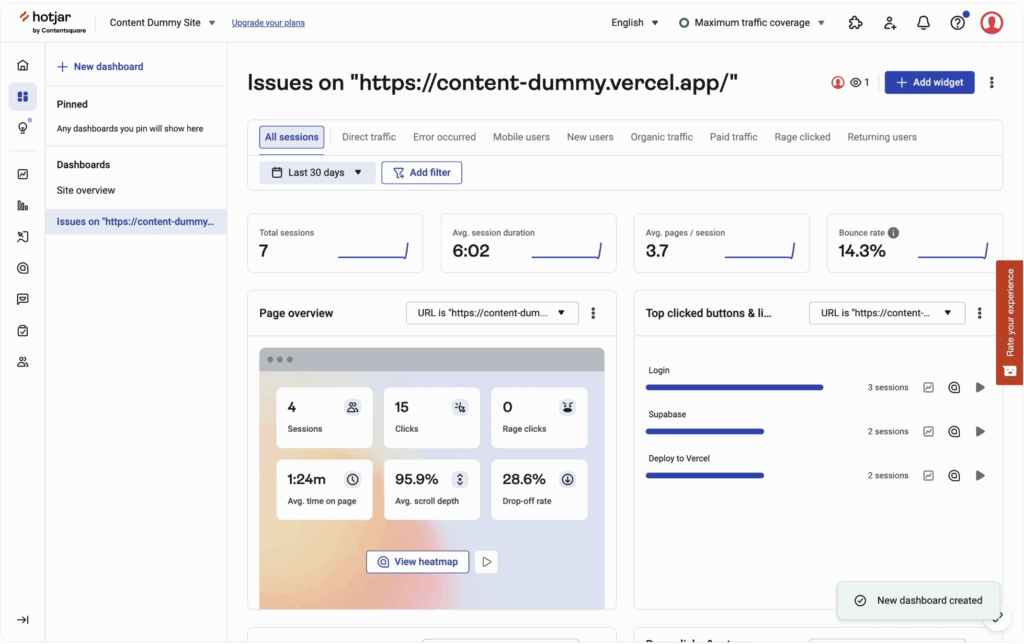
PLG capabilities:
- Heatmaps showing click patterns
- Session recordings of user behavior
- In-app surveys and feedback
- Funnel analysis
Why it enables PLG: Visual data reveals friction points. Watch real users struggle and fix those areas.
Pricing: Free tier available. Paid plans start at $39 monthly.
ProductBoard
ProductBoard manages product feedback and roadmap prioritization. Customer insights inform what to build next.

PLG capabilities:
- Centralized feedback collection
- Feature request tracking
- Roadmap planning
- User segmentation
- Integration with support tools
Why it enables PLG: User feedback drives product direction. Build what users actually need for expansion.
Pricing: Starts at $25 per user monthly.
Category 5: Integration and Data Tools
PLG requires connecting product usage data to marketing, sales, and support systems. Integration tools make this possible.
Segment
Segment collects product event data and routes it to analytics, marketing, and support tools. One integration powers everything.
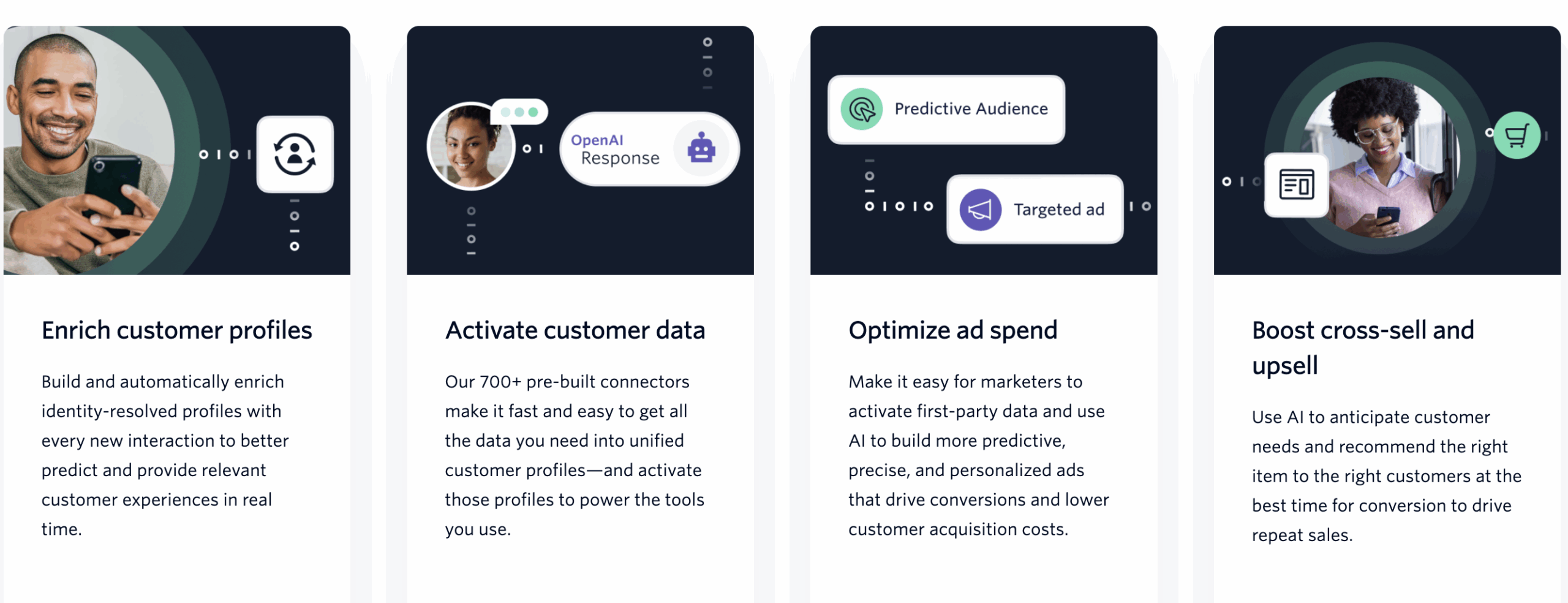
PLG capabilities:
- Single API for event collection
- Routes data to 300+ tools
- Data warehouse integration
- Real-time event processing
- User identity resolution
Why it enables PLG: Unified data infrastructure. Product usage informs every team.
Pricing: Free tier for up to 1,000 monthly users. Growth plans scale with volume.
Zapier
Zapier connects tools without custom integration work. Automate workflows between products, CRMs, and marketing platforms.
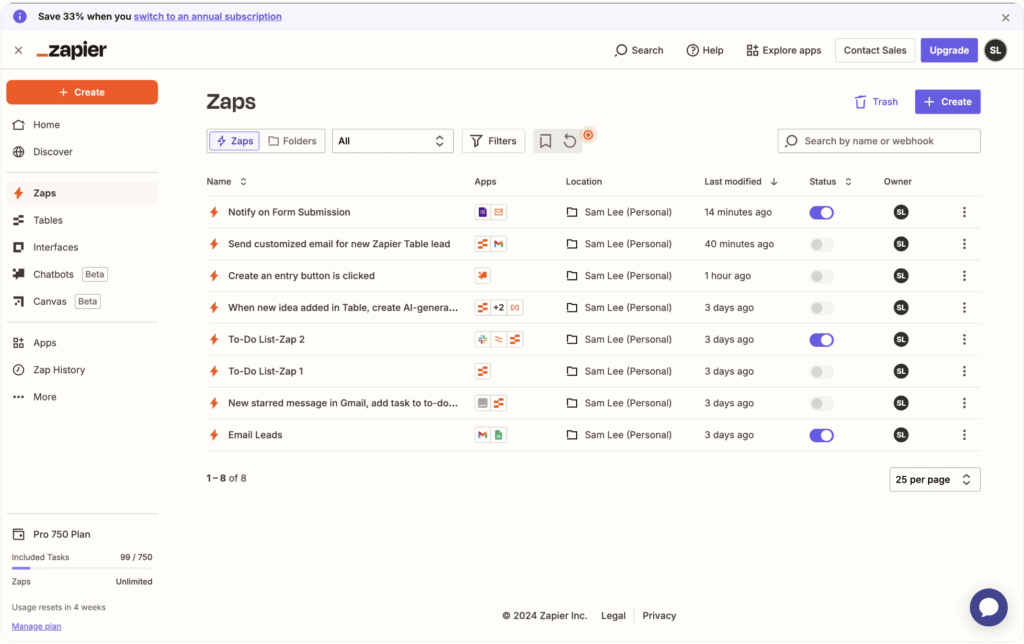
PLG capabilities:
- No-code integration between 5,000+ apps
- Automated workflows
- Data syncing
- Trigger-based actions
Why it enables PLG: Quick integrations without engineering. Product data flows to relevant teams.
Pricing: Free tier available. Paid plans start at $19.99 monthly.
What SaaS tools can you use to build your PLG Tech Stack?
Different PLG stages require different tool combinations. Start with essentials and expand as needs grow.
Early Stage PLG Stack (Pre-Product Market Fit)
Focus on core adoption and basic analytics.
Essential tools:
- User onboarding: Product Fruits for AI-powered activation
- Analytics: Mixpanel or Amplitude free tier for basic tracking
- Communication: Intercom Starter for support chat
- Feedback: Typeform for user surveys
Total cost: $1,000-$1,500 monthly
This stack handles core PLG needs without breaking early budgets. Users can activate themselves. Teams understand basic usage patterns. Support happens in-product.
Growth Stage PLG Stack (Post-PMF, Scaling)
Add sophistication as user base grows.
Core tools:
- User onboarding: Product Fruits with full AI capabilities
- Analytics: Amplitude Growth or Mixpanel Enterprise for deep insights
- Communication: Intercom with automation
- Feedback: ProductBoard for roadmap planning
- Integration: Segment for unified data
- Session replay: Hotjar for visual insights
Total cost: $3,000-$5,000 monthly
This stack provides comprehensive visibility and sophisticated user guidance. Teams can optimize every stage of the user journey.
Enterprise PLG Stack (Large-Scale Operations)
Enterprise tools handle complex requirements at scale.
Comprehensive tools:
- User onboarding: Product Fruits Enterprise
- Analytics: Amplitude or Mixpanel with data warehouse
- Communication: Intercom Enterprise
- Feedback: ProductBoard Enterprise
- Integration: Segment Business tier
- Testing: Optimizely for experimentation
- Data warehouse: Snowflake for analysis
Total cost: $10,000-$20,000+ monthly
Enterprise stacks support sophisticated PLG operations across multiple products and global teams.
What are the Essential PLG Metrics you must track?
Tools enable measurement. Track these metrics to assess PLG health.
Activation Metrics
Activation rate: Percentage of signups that complete meaningful first action. Industry average is 25%.
Time to value: How long from signup to first success. Faster is better. Keboola reduced this by 29% with Product Fruits.
Aha moment completion: Percentage experiencing the core value proposition. This moment predicts conversion.
Engagement Metrics
Daily/weekly/monthly active users: How many users engage regularly. Healthy PLG shows consistent growth.
Feature adoption rate: Percentage of users adopting key features. Low adoption suggests guidance problems.
Product usage depth: How many features users engage with. Shallow usage predicts churn.
Conversion Metrics
Trial-to-paid conversion: What percentage of trial users convert. Strong PLG achieves 15-25% conversion.
Time to conversion: How long trials take to convert. Shorter cycles indicate clearer value.
Expansion rate: Percentage of customers expanding usage. Net revenue retention above 100% signals healthy PLG.
Retention Metrics
Churn rate: Percentage of customers leaving. Monthly churn under 3% is strong for PLG.
Retention cohorts: How different user cohorts retain over time. Improving cohorts show better product.
Product qualified leads (PQLs): Users showing expansion signals based on usage. These convert at higher rates than marketing qualified leads.
How do you implement your PLG Strategy with your SaaS tools?
Having tools doesn't guarantee PLG success. Implementation strategy matters.
Start with Onboarding Excellence
PLG lives or dies on first user experience. Users who activate quickly convert. Users who get confused churn.
Implement robust onboarding first. Product Fruits' AI-powered approach works well here because it reduces manual work and Elvin AI can even generate tours on demand for users who are struggling. See how it works for implementation details.
Strong onboarding provides foundation for everything else. Users who never activate won't engage with features, provide feedback, or expand usage.
Instrument Product Analytics
You can't optimize what you don't measure. Implement comprehensive event tracking early.
Track every meaningful user action. Button clicks, feature usage, workflow completion, help article views. This granular data reveals optimization opportunities.
Segment or similar integration platforms make this easier by routing data to multiple tools from single implementation.
Enable Self-Service Support
PLG users expect instant answers without tickets. Implement conversational AI like Elvin Copilot that provides immediate responses from knowledge bases.
Reducing support friction directly improves conversion. Users who get stuck and can't get help churn. Instant answers keep users progressing.
Chemsoft reduced support tickets by 30% using this approach. Support teams focus on complex issues while AI handles common questions.
Create Feedback Loops
Understand what users need through systematic feedback collection. Don't guess at problems. Ask users directly.
Implement in-app surveys at key moments. After feature usage. When users show confusion signals. Following support interactions.
This feedback informs product roadmap. Build what users actually need for expansion rather than what seems interesting.
Optimize Continuously
PLG requires constant iteration. A/B test onboarding flows. Experiment with activation sequences. Try different communication timing.
What works for one user segment might not work for another. Test extensively across segments to find optimal approaches.
Product Fruits includes A/B testing capabilities for optimizing AI-generated guidance. Teams can test different approaches and adopt what works best.
What mistakes should you avoid when choosing SaaS tools for Product Led Growth?
Tool sprawl without strategy. Adding tools randomly creates complexity without improving outcomes. Choose tools that address specific problems.
Analytics without action. Collecting data means nothing without using it. Analyze metrics and implement changes based on findings.
Over-automating communication. Too many in-app messages annoy users. Be selective about when to communicate.
Ignoring mobile users. If users access products on mobile, experiences must work there. Test everything on actual mobile devices.
Expecting tools to fix product problems. No tool makes bad products good. PLG requires genuinely valuable products. Tools optimize already-working products.
Under-investing in onboarding. Many teams spend more on analytics than onboarding despite onboarding having bigger impact on PLG success.
How should you choose what SaaS tools to use for Product Led Growth?
Select tools based on current stage and specific needs:
If activation is weak: Start with user onboarding tools like Product Fruits. Nothing else matters if users don't activate.
If you lack usage insights: Implement product analytics like Mixpanel or Amplitude. Data drives decisions.
If support costs are high: Add conversational AI support. Elvin Copilot resolves 60%+ support conversations without human intervention.
If users request features: Implement feedback tools like ProductBoard. Build what users need for expansion.
If data is fragmented: Add integration platform like Segment. Unified data enables better decisions.
Most teams should start with onboarding and analytics, then expand tooling as PLG motion matures.
Explore different use cases showing how companies implement PLG strategies. Compare adoption tools or learn about AI-driven adoption approaches.
Ready to enable product-led growth? Use Product Fruits and let Elvin AI activate users automatically without sales intervention. See how AI agent solutions work or explore switching from traditional tools
FAQs:
What’s the fastest way to improve activation?
Implement onboarding that personalizes guidance and answers questions in-product. AI-driven onboarding (e.g., Product Fruits) removes friction and scales without sales or CSMs.
Which onboarding tools should I compare first?
Start with Product Fruits (AI onboarding + copilot + analytics), Appcues (no-code tours), and Userpilot (tours + analytics). Key trade-offs: AI vs. manual builds, price, and data depth.
Why is Product Fruits emphasized in this guide?
It combines AI-generated onboarding, behavioral triggers, instant answers via Elvin Copilot, and onboarding analytics —reported outcomes include ~64% average activation (vs. ~25% SaaS baseline) and large churn reductions.
Is AI onboarding worth it vs. manual tours?
AI reduces build/maintenance, adapts guidance by behavior, and answers questions instantly—ideal for self-serve scale. Manual setups offer control but are slower to iterate.
How do I prove ROI to leadership?
Model impact from: higher activation rate, faster time-to-value, improved trial-to-paid, fewer tickets, and increased NRR. Start with a pilot on one key journey and report deltas.
Where should I start this quarter?
Ship AI-powered onboarding, define and instrument core events, launch in-app help, and add one feedback loop. Review metrics weekly; run two A/B tests per month on activation.


Weekly newsletter
Get the latest releases, tips, articles, and exclusive interviews delivered to your inbox weekly—no spam!