Feature launch: 7 proven strategies to drive adoption


TL;DR: A feature launch is not the day you ship - it's the campaign that gets users to notice, understand, and actually use what you built. Most features never get that campaign, so they quietly go unused. To beat that, plan before you ship (goals, segments, success metrics), then run a multi-channel rollout: in-app announcements, email, webinars, social, contextual hints, guided flows, and a briefed support team. Close the loop with feedback and usage data so every launch teaches the next one.
It's every product manager's nightmare: after months of building an exciting new feature, adoption falls flat. Execution alone is hard enough - Gartner found that 45% of product launches are delayed by at least a month (Gartner, 2019). Shipping late is one risk. Shipping to silence is the bigger one.
Users don't adopt what they don't notice or understand. A product manager's job doesn't end at shipping - you also need to craft feature announcements that captivate customers and guide them to value.
This article walks through how to introduce new features effectively, from pre-launch planning to a multi-channel rollout and the feedback loop that improves your next release. ⬇️
Feature launch vs. product launch: this guide is about driving adoption of a new feature among your existing users, mostly in-app. If you're taking a whole new product to market, start with our guide to launching a new product instead, then come back here for the in-app adoption playbook.
Before the 7 strategies: set the launch up to win
The best channels in the world won't rescue a launch with no plan behind it. Before you announce anything, lock down three things.
Goals. Decide what "successful adoption" means for this feature in a specific number, not a vibe. Pick a target adoption rate and a time window - for example, 20% of eligible users activating the feature within 30 days. A concrete target tells you whether the launch worked.
Segments. Not every user cares about every feature. Group users by role, plan, or behavior, and map each segment to the message and channel that fits it. A power user who requested the feature needs a different nudge than a new signup who's still learning the basics.
Success metrics. Define how you'll measure adoption before launch day: feature activation, repeat usage, time-to-first-use, and the support-ticket and NPS trends around it. You'll use these again in the post-launch section to judge results and iterate.
With goals, segments, and metrics in place, the seven strategies below become a coordinated campaign rather than scattered announcements.
1. Launch new features through in-app announcements
Your users are already in your app, so that's where the launch should start. In-app announcements put the spotlight exactly where it matters and reach users in real time, whether on desktop, mobile, or browser. Segment first, then match the format to the message. Each announcement is a call to explore: learn more, try it now, or upgrade to unlock it.
Product Fruits gives you four in-app formats, each suited to a different job:
Banners sit at the top or bottom of the screen and deliver a key message without interrupting the experience. Space is tight, so lead with the benefit and include a link so users can explore. If you're not sure how to phrase it, Product Fruits' built-in AI, Elvin, drafts banner copy from a short prompt - give it at least 11 characters, and the more context you add, the better the result.
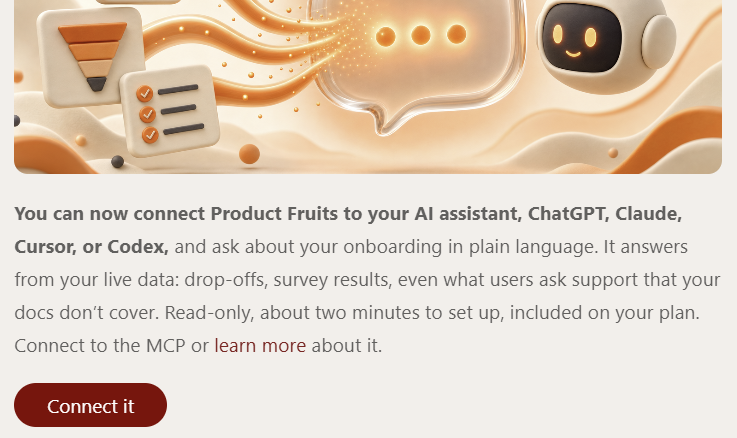
Newsfeed is the right tool for a steady stream of updates. It publishes content and keeps a browsable history users can return to, with room for a cover image to catch attention. You can include a simple CTA to direct/drive users to the annouced feature.
Pop-ups appear over other content, so they command attention and should be reserved for key releases or critical updates. Figma uses them well, showing how a new feature works with a clear call to action that leads into its release notes.
Release notes give users a clear, organized timeline of updates – new additions, fixes, and improvements – so they can see how the product has evolved. ClickUp does this nicely with short video explainers.
Beyond the app, a website banner puts your release front and center for visitors who aren't logged in, driving awareness and clicks to learn more.
2. Use emails to call attention to the new feature
A feature launch email updates users without cluttering your UI with extra messages. People check email regularly, so it's a reliable way to pull them back into your platform and into the right onboarding flow.
Keep it visual and benefit-led. Product Fruits does this by including an image of the new feature and highlighting the main benefits up front. ClickUp goes further with a short video that shows users exactly how to use the feature straight from the email. For more patterns, see our onboarding email examples.
3. Enhance feature launches with engaging webinars and tutorials
Webinars combine education and social proof in one engaging format. They let you explain a feature in depth and show real customer success stories that prove its practical impact.
A well-structured webinar helps you:
- Share the strategic vision behind the feature, aligning users with your product's direction
- Walk users through practical use cases and implementation tips that make adoption seamless
- Highlight success stories that build confidence and show real-world value
Advertise the webinar inside the app ahead of time – a simple banner or pop-up is enough – so users know it's coming and want to join.
4. Promote your new feature on social media
People are "chronically online" more than ever, so social is a natural place to build hype around a release. Design scroll-stopping posts aimed at your target audience, including people who aren't active customers yet. Experiment with formats – short video, GIFs, and the occasional well-placed meme – and ask the whole team to post from their own accounts to widen reach. Product Fruits did exactly this when announcing its AI-powered onboarding.
5. Use hints
Hints – beacons and tooltips – are ideal for feature launches because they offer contextual, always-available guidance without interrupting the experience. Unlike a one-time tour, hints stay put, giving on-demand detail about a new feature exactly where it lives in the UI.
How to use hints for a feature release:
- Explain the feature in place with text, links, or short GIFs so users grasp what's new and why it helps
- Launch a guided flow or a survey directly from a hint, letting users explore at their own pace
- Add as many hints as you need without cluttering the interface, so help is there without feeling heavy
Hints let users discover features on their own terms, which is why they're such a dependable part of feature-release communication.
6. Use guided product tours and flows
Guided experiences act like a compass for users learning a new feature. They're especially valuable for complex products, because they shorten the time it takes to reach the "aha moment." Done well, guided experiences:
- Teach the most important actions based on the user's role, simplifying the learning curve
- Encourage users to do, not just watch – learning by doing sticks far better
- Lower the barrier to starting, which lifts continued use and retention
Static tours are the classic version of this. The modern version is Product Fruits Flows – multi-step guided experiences that react to what the user does. A flow can wait for a condition to be met, branch into different paths, and only advance once the user completes the expected action. That behavior-awareness is what makes flows so effective for feature adoption: instead of a fixed slideshow, you walk each segment through the exact path that gets them to value.
You don't have to build one from a blank canvas, either. With Record with Elvin, you navigate your product, click the elements you want to include, and Elvin drafts the card content for each step – you refine from there.
7. Collaborate with the support team
Your support team isn't just there to fix problems – they help build excitement around a release. Bring them in before and after launch.
Inform the team. Run a short training session or share documentation so support is fully up to speed. A confident, knowledgeable team builds customer trust, and insider knowledge makes clients feel valued.
Create hype for existing customers. Keep loyal customers in the loop about what's coming and ask for their feedback. When support can explain how a feature improves a customer's specific workflow, the conversation gets personal and persuasive.
Keep the post-launch role in mind. Because support talks to customers directly, they gather real-time signal on what's working, what's confusing, and what to fix – insight that shapes your next iteration.
Keep self-service current. Many users check your help content before they ever open a ticket, so update your articles, tutorials, and videos to cover the new feature. This is also where Elvin Copilot earns its keep: it answers user questions in a chat-style widget using only the content sources your team maintains, so a well-documented feature gets explained instantly, around the clock, without adding to the support queue.
Post-launch: measure, gather feedback, and iterate
Shipping and announcing is only half the job. The launch isn't successful until users adopt the feature and keep using it – which brings you back to the metrics you defined up front.
Track a small set of signals rather than everything at once:
Keep a feedback loop open with feedback widgets and NPS surveys so you always know how the change landed. Then let the data guide the next release.
If you'd rather ask questions in plain language than dig through dashboards, connect Product Fruits to an AI assistant through the Product Fruits MCP integration. It's a read-only connection using OAuth sign-in, so you can ask an assistant like Claude to review a flow's performance, find where users drop off, or summarize Elvin conversations about the new feature – no exporting required.
For a ready-made version of everything above, grab our feature launch checklist for an end-to-end breakdown. And if you're ready to build the in-app comms right now, start a free trial.
Key takeaways
- Successful feature launches are multi-channel: in-app announcements, email, webinars, social, and support working together
- Plan before you ship – set an adoption goal, segment your users, and define success metrics up front
- Meet different learning styles with a mix of webinars, guided flows, and contextual hints
- Flows beat static tours for adoption because they branch and react to user behavior
- Involve support before and after launch, and keep self-service current so Elvin Copilot can answer for you
- Close the loop: track adoption, gather feedback, and feed what you learn into the next release
FAQ
Why do some new features fail to gain adoption?
New features fall flat when users either don't notice them or don't understand why they matter – which happens far more often than teams expect. The fix is clear, repeated communication across multiple channels – in-app, email, webinars, social, and support – so users see the feature, grasp its value, and know how to use it.
What are the most effective channels to announce a new feature?
The strongest results come from a multi-channel approach. Combine in-app announcements (banners, newsfeed, pop-ups, release notes), email, webinars, social posts, and support outreach so users encounter the feature in different contexts, both inside and outside your product. Match each channel to the segment and message rather than blasting everyone the same way.
How can I promote a new feature in-app without overwhelming users?
Start with lightweight, contextual formats: banners, newsfeed entries, and hints that are visible but not intrusive. Reserve pop-ups for high-impact or time-sensitive updates. Always segment by role, behavior, or plan so only the right users see each message at the right moment.
What's the difference between a product tour and a flow?
A product tour is a mostly fixed sequence of steps. A flow is a multi-step guided experience that reacts to what the user does – it can wait for a condition, branch into different paths, and only advance when the user completes an action. For feature adoption, flows tend to perform better because they guide each user down the path that actually gets them to value.
What should my support team do during a feature launch?
Support is part of the launch engine, not just a ticket queue. Train them on the feature in advance, give them talking points and resources, let them tease what's coming to loyal customers, and then use their post-launch conversations as a rich source of feedback. Keeping help content current also lets Elvin Copilot answer common questions automatically.
How can I measure whether my feature launch was successful?
Track a focused set of signals: feature adoption rate, time to first use, repeat usage, support ticket volume, and NPS or CSAT trends. Define these before launch, set a target and time window, and keep a feedback loop running with in-app surveys and feedback widgets so you can see what's working and iterate quickly.
Conclusion
A feature launch lives or dies on adoption, and adoption is something you engineer – not something you hope for after shipping. Plan the launch before you release, run a coordinated multi-channel rollout, and keep a feedback loop open so every launch makes the next one sharper. Product Fruits brings the whole playbook into one platform: in-app announcements, guided flows with Elvin, hints, surveys, and analytics, so your team can move from "we shipped it" to "users love it" without stitching five tools together. Book a demo or try Product Fruits for free and see how much smoother your next feature launch can be.


Weekly newsletter
Get the latest releases, tips, articles, and exclusive interviews delivered to your inbox weekly—no spam!