Beyond the Onboarding Checklist: How Adaptive Product Tours Are Rewriting the Rules of Digital Adoption


Product Fruits' adaptive product tours use AI and a technology called annotations to deliver contextual, on-demand user guidance - helping SaaS companies increase product adoption and reduce support load without manual tour authoring.
Product Fruits is a digital adoption platform that helps SaaS companies onboard, guide, and retain users through in-app experiences. Its AI engine, Elvin, now powers a new generation of adaptive product tours that respond to individual users in real time - representing a fundamental shift in how digital adoption works.
For years, product teams have approached user onboarding the same way. Build a tour. Define the steps. Fire it at every new user the moment they land on your app. It was predictable, scalable, and, if we're being honest, often ignored.
That era is ending. And what's replacing it is something far more interesting. Something that can help you get rid of more than 50% of support tickets and that helped us resolve more than two-thirds of support questions without human intervention (see more detailed stats below).
See adaptive product tours and annotations in action - watch video from our recent webinar (video starts with the adaptive tours topic).
The Problem With "Start From Step One"
Traditional product tours share a fundamental flaw: they assume every user is starting from the same place, with the same questions, at the same moment. In reality, your users are scattered across your application at any given time. One is on the dashboard. Another just landed on the integrations page. A third is three-quarters through a workflow they started yesterday.
A static tour doesn't care. It starts at step one regardless. And when a user is already at step four by their own thinking, being dragged back to the beginning doesn't reduce friction - it creates it.
This is the core problem that adaptive product tours are designed to solve.
A New Paradigm: Contextual, On-Demand Guidance
The shift happening across the digital adoption market right now is a move toward guidance that meets users where they are - literally. Rather than pre-scripted sequences triggered on a schedule, the new model delivers help in the context of what a user is doing, in the specific part of the application they're in, at the precise moment they need it.
This is no longer just a conceptual aspiration. AI has made it operational. Industry analysts like Gartner have identified this contextual, on-demand approach as the direction the market is heading - not in years, but now.
The key enabler of this shift within Product Fruits is a technology called annotations.
How Adaptive Tours Differ From Traditional DAP Tools
Most digital adoption platforms (DAPs) - including established names in the category - rely on manually authored, linear tour sequences. Administrators define every step, every trigger, and every persona segment in advance. Product Fruits' annotation-based approach inverts this model: instead of authoring tours, teams teach Elvin what the application looks like, and Elvin generates tours dynamically in response to real user queries. The result is a system that scales without proportionally scaling authoring effort.

What Are Annotations? Think Auto-Subtitles for Your App
The simplest way to understand annotations is to think of them as auto-generated subtitles for your application - a layer of structured, AI-readable context that describes what every element on your screen actually is and does.
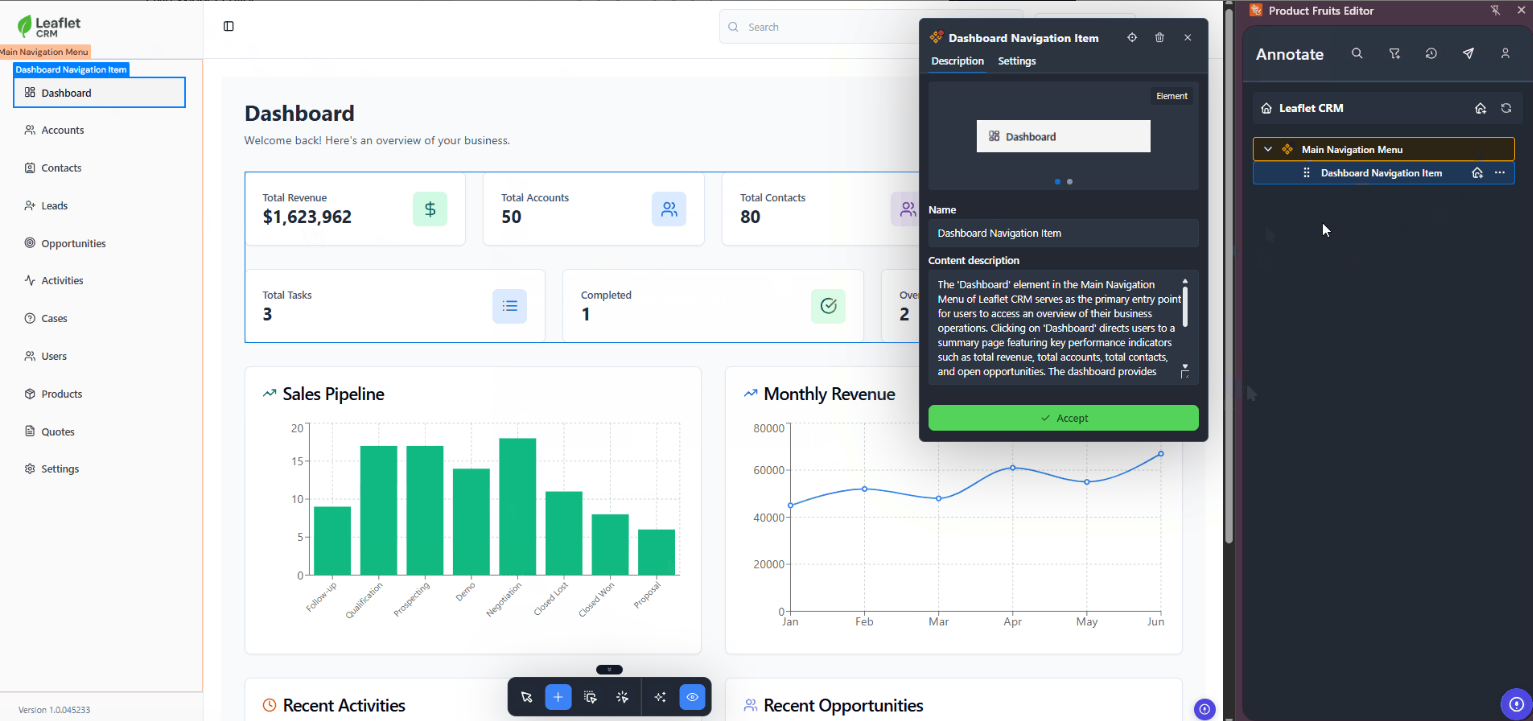
Here's how it works in practice: Using the Product Fruits annotation extension in Chrome, an administrator navigates to Elvin Copilot → Teach → Annotations and begins clicking through their application. When they click on an element - a menu item, a tab, a button - Elvin automatically generates a title and description for it. No manual writing required. The administrator can review and edit these descriptions, but in most cases, Elvin reads the visual and contextual signals on the screen and gets it right on its own.
Annotations are built hierarchically: start with the main navigation, go deeper into subpages, then down to individual elements. This tree structure is what allows Elvin to understand not just what something is, but how it relates to everything else in your application. When a user later asks "How do I connect to HubSpot?", Elvin doesn't just search a knowledge base - it reads its subtitles, understands the relationship between Settings → Integrations → HubSpot, and builds a real-time guided walkthrough tailored to that question.
This is the critical distinction between the traditional approach - where Elvin drew on a connected knowledge base to answer questions - and the new annotation-powered approach, where Elvin develops a living, structured understanding of your application itself.
Adaptive in Action: What This Looks Like for Users
The demo that crystallizes this best involves three users, all asking the same question from different parts of the app.
Nancy is in Settings. Ian is in Accounts. A thir d user is on the Leads page. All three ask Elvin how to connect to HubSpot. In a traditional tour, all three would be sent back to step one. With adaptive tours powered by annotations, Elvin checks where each user is, skips the steps they've already completed, and begins guidance from their actual current position.
Nancy gets pointed straight to the Integrations tab - she's already in Settings. The user on Leads gets the full path: Settings, then Integrations, then HubSpot. Same destination, different starting points, guidance that respects where each person actually is.
This also addresses a long-standing headache for product teams: broken CSS selectors. Because Elvin is no longer relying solely on CSS element targeting, but on a richer understanding of each element's identity, position, and surrounding context, it becomes far more resilient to the kind of dynamic DOM changes that used to break tours silently and inexplicably. Elvin generates element "fingerprints" - capturing position, surrounding elements, and visual context - and the team is actively developing self-healing capabilities that will automatically fix broken selectors and URLs without any manual intervention.
Complementary, Not a Replacement
It's worth being clear: adaptive tours don't make static tours obsolete. There's still a strong case for structured, step-by-step onboarding sequences that walk every new user through the same foundational journey. But once that tour ends, users diverge. They have different questions, hit different walls, and need help in different places.
This is where adaptive tours do their best work - not as a first-day onboarding tool, but as an always-on layer of contextual guidance that catches users wherever they fall off the path. Think of it as the safety net beneath your structured onboarding. The two approaches work best together: static tours establish the foundation; adaptive tours handle everything after.
The Results: What Customers Are Seeing
Product Fruits currently has over 200 customers testing this capability, with more than 100 running it in production. The early numbers are striking:
- ~56% average reduction in support tickets across customers using adaptive guidance
- ~69% reduction in support questions when Product Fruits deployed Elvin internally - meaning roughly seven out of ten questions that would have reached the support team are now handled by Elvin directly
- Real-time tour generation with no pre-authoring required once annotations are in place
That's not a marginal efficiency gain. That's a structural change in how support load scales with your user base.
Getting Started With Annotations
The annotation process is deliberately low-friction. Administrators install the Chrome extension, connect it to their Product Fruits workspace, and begin clicking through the application's most critical user paths. Elvin handles the description generation automatically. Once sections are annotated and published, Elvin can immediately begin using them to generate dynamic guides for end-users.
You don't need to annotate your entire application at once. Focusing on the highest-traffic flows - the paths where users most often get stuck or submit support tickets - delivers immediate value. Coverage can be expanded incrementally over time.
Even without annotations, Elvin can answer user questions if knowledge base sources are connected. But dynamic guide generation - the real-time, position-aware, step-skipping walkthrough capability - requires annotations. That's the unlock.
Frequently Asked Questions
What is a digital adoption platform (DAP)?
A digital adoption platform is software that guides users through a product or application using in-app experiences like tours, tooltips, checklists, and AI-powered assistance - reducing the need for external training or support tickets and accelerating time-to-value for new users.
What are adaptive product tours?
Adaptive product tours are AI-generated, on-demand walkthroughs that adjust to a user's current location within an application and the specific question they're asking - as opposed to static tours that always start at step one regardless of context. They are generated in real time by an AI engine rather than pre-authored by an administrator.
How does Product Fruits use AI for product adoption?
Product Fruits uses an AI engine called Elvin, which learns an application's structure through an annotation process and uses that knowledge to generate contextual, real-time guided tours for end-users - without requiring tour authors to manually script each path. Elvin can also answer questions using connected knowledge base sources when no annotation-based tour is needed.
What results have companies seen with AI-powered product tours?
Product Fruits customers using Elvin's adaptive guidance have reported an average support ticket reduction of approximately 56%, with some teams seeing reductions as high as 69-70% of user questions resolved without reaching a human agent.
How is Product Fruits different from other product adoption platforms?
Most adoption platforms require administrators to manually author every tour step and user segment in advance. Product Fruits' annotation-based system allows teams to teach the AI about their application once, and then Elvin generates tours dynamically for each user based on where they are and what they're asking - eliminating the need to pre-build paths for every possible scenario.
Do Product Fruits annotations replace the need for a knowledge base?
While you can build adaptive product tours on annotations alone, we still recommend using a knowledge base as more detailed source of information both for Elvin answers and guidance and for your users as well. Knowledge base answers questions in detailed text, while annotations enable step-by-step visual guidance generated dynamically from the user's current position in the app. Both sources can be active simultaneously, and Elvin determines which response type is most appropriate for each query. You can use built-in knowledge base in Product Fruits and/or connect external sources be it your online knowledge base, other web sources or documentation.
What is the annotation setup process like?
You (or your product adoption admin) only install a Chrome extension, navigate to Elvin Copilot → Teach → Annotations, and click through the application elements you want Elvin to understand. Elvin auto-generates titles and descriptions for each element, which administrators can review and edit. Annotations are organized hierarchically (main menu → subpages → individual elements) and published when ready. The process for a core user flow typically takes minutes, not hours.
Can adaptive tours work across multiple URLs or domains?
Currently, Elvin's adaptive tour generation works across URLs within the same domain. Cross-domain guidance is on the product roadmap.
The Bottom Line
The promise of digital adoption software has always been this: help users succeed in your product without hand-holding them every step of the way. Adaptive product tours, built on annotation technology and delivered by AI, are the closest the industry has come to actually keeping that promise.
The tour that starts where you are, skips what you already know, and guides you exactly where you need to go - that's not a nice-to-have anymore. For users who expect software to be intelligent, it's becoming the baseline expectation.
Product Fruits is a digital adoption platform offering in-app tours, hints, checklists, announcements, and AI-powered guidance via Elvin. Annotations and adaptive tour generation are currently in early access. Book an Elvin demo to see it in action.


Weekly newsletter
Get the latest releases, tips, articles, and exclusive interviews delivered to your inbox weekly—no spam!