What Role Do AI Agents Play in Optimizing SaaS User Adoption?


Picture this: You've just launched your shiny new SaaS product. You've spent months perfecting the features, polishing the UI, and getting everything just right. But when users sign up, they're clicking around confused, abandoning their onboarding halfway through, and churning before they even experience your product's real value.
Sound familiar? It's the nightmare scenario every SaaS founder dreads—and it's exactly where AI agents are stepping in to change the game.
Up to 40% of customers abandon the onboarding process due to its complexity and time consumption. Think about that for a second. Nearly half of your hard-won users are walking away before they even get started. That is why user onboarding and digital adoption tools like Product Fruits were born. They segment and guide users to reach their "aha moment" and achieve their desired goal. At companies like Keboola, marketers see campaign workflows first, while developers are guided directly to API setup—resulting in a 29% faster onboarding time and 8% higher feature adoption.
But even as good as it is, compared to latest AI tools, this traditional onboarding is like handing someone thick manual and saying "good luck." It's static, one-size-fits-all, and at times may be about as engaging as watching paint dry. So switch to high gear and race ahead with intelligent systems that actually understand their users: AI agents come in to save the day.
TLDR: AI agents transform SaaS onboarding by actively guiding users, similar to a GPS compared to a static map. For instance, Product Fruits' AI agents personalize onboarding based on user roles, resulting in 29% faster onboarding and higher feature adoption. They learn from user interactions, significantly reducing trial churn by 70% and improving paid conversions. Even after onboarding, AI agents provide ongoing support, reducing support ticket volume by 30%. Overall, AI agents enhance the user experience by providing intelligent, adaptive guidance at every step.
https://vimeo.com/1132059465?share=copy&fl=sv&fe=ci
Elvin AI creates dynamic tours just when and where users need them. It can do it, because you can teach it to know your product (SaaS) through so-called annotations.
What are AI agents and how do they improve SaaS user adoption?
Think of AI agents as the difference between a GPS navigation system and a paper map. One actively guides you, adapts to traffic in real-time, and reroutes when you take a wrong turn. The other just sits there, static and unhelpful.
That’s exactly how AI agents transform SaaS onboarding and adoption—they don’t just display features; they guide users dynamically through the product experience.
Take Product Fruits AI agent Elvin, for example. Its AI agents act like the GPS of your SaaS product:
When a new user logs in, the AI detects their role and behavior, then personalizes the onboarding flow. If a user hesitates on a screen for too long, the AI agent proactively steps in—just like a GPS suggesting an alternate route.
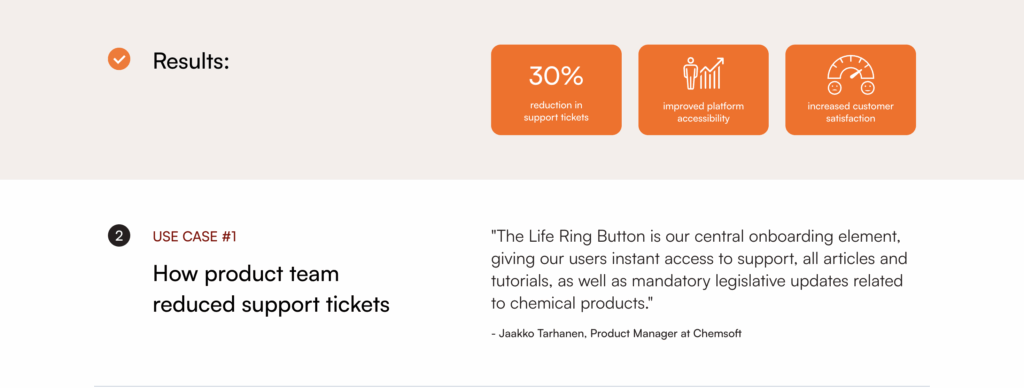
And the AI doesn’t stop there—it learns from every interaction and can be combined with more traditional onboarding tools like checklists Even post-onboarding, AI agents keep optimizing. When Chemsoft used Product Fruits’ traditional (non-AI) help center as a 24/7 guide, surfacing multilingual resources and news updates contextually, their support ticket volume dropped 30% as users found what they needed faster. New Product Fruits AI powered help center with Elvin onboarding assistant easily doubles that and cuts the number of tickets that reach tech support by 60 % or more - and some startups like adeus can cover all their live support needs with AI Copilot.
In short, AI copilots and agents don’t just tell users where to go—they guide them intelligently, learn from their journey, and continually improve the route.
Just like a GPS makes every driver feel confident on any road, AI agents make every SaaS user feel guided, supported, and understood from the very first click.
How are AI agents different from AI chatbots?
AI agents aren't your typical chatbots that spit out canned responses. Traditional chatbots follow scripted, rule-based logic and can only answer predefined questions.
AI agents, on the other hand, use machine learning, context awareness, and adaptive reasoning to understand user intent, act autonomously, and learn continuously.
Think of the difference as a GPS vs. a paper map—AI agents guide, adapt, and reroute in real time.
These are autonomous systems that can:
- Perceive what users are struggling with in real-time
- Reason about the best way to help them
- Act by providing personalized guidance, triggering workflows, or surfacing relevant features
- Learn from every interaction to get smarter over time
Here at Product Fruits, we’ve seen firsthand how companies use our AI agents to reduce customer support tickets and boost product adoption.
FeatureAI AgentsAI ChatbotsResponse TypeProvides personalized guidance and actionsDelivers canned responses based on scriptsLogicUses machine learning and adaptive reasoningFollows scripted, rule-based logicUser UnderstandingUnderstands user intent and contextLimited understanding, answers predefined questionsAutonomyActs autonomously and can take initiativeResponds only when prompted by usersReal-Time AdaptationGuides and reroutes in real-timeInflexible to user contextLearning CapabilityLearns from every interaction to improve over timeGenerally does not learn or adaptActionable HelpProvides personalized guidance and triggers workflowsOffers answers but lacks proactive supportAdoption RateAdopted by 85% of organizations in workflowsWidely used but less impactfulUse CasesReduces support tickets, boosts product adoptionBasic customer service inquiries
What are the key benefits of using AI agents in SaaS onboarding?
AI agents transform onboarding through:
- Personalization at scale – Tailoring steps to user role, behavior, and goals.
- Proactive support – Fixing friction before users notice it.
- Adaptive learning – Evolving flows based on user progress.
- 24/7 availability – Offering instant help across time zones.
- Data-driven insights – Turning every interaction into optimization data.
For example, Companies like Keboola, Adeus, FitnessPlayer, and Chemsoft saw double-digit gains in adoption and efficiency after implementing Product Fruits’ AI agent.
What kind of ROI can companies expect from AI agents?
Let's talk brass tacks. What's the actual return on investment? 43% of enterprises are allocating over half of their AI budgets to agentic AI, and 62% of organizations expect more than 100% return on investment from the deployment of agentic AI.
While real life shows that not all implementations go according to plan, getting a strong ROI from AI copilots or agents is no wishful thinking - a well-targeted implementations show measurable outcomes:
- Users of AI agents saw a 42% reduction in documentation time, saving approximately 66 minutes per day.
- Conversational shopping agents drove a 35.2% increase in online conversion rate and a 39.8% higher revenue per visit.
- Integration of AI agents has led to a 30% increase in operational efficiency in large organizations.
- Collaborations between humans and AI agents have led to a 60% increase in productivity per worker in marketing experiments.
Organizations report measurable returns:
- 30% boost in operational efficiency
- 42% reduction in documentation time
- 35% higher conversion rates
- 60% productivity increase in hybrid AI-human workflows
- Additionally, 62% of companies expect over 100% ROI from agentic AI deployment within the first year.
It is, however, important to focus on benefits that reach the company's bottom line, rather than providing individual employees with more time for coffee breaks - and this is where solutions like support copilots and AI agents come into play.
How do AI agents use data to improve SaaS user adoption rates?
AI agents continuously log interactions to uncover trends such as:
- Common pain points in onboarding
- Feature drop-off zones
- Most-searched help topics
- User segment behavior differences
This feedback loop gives product teams actionable insights to refine UX, update content, and optimize conversion paths.
How do AI Agents Transform SaaS User Adoption?
1. AI Agents Transform SaaS User Adoption by personalizing user onboarding
Here’s how they do it.
Imagine walking into a store where the sales assistant already knows your name, remembers what you bought last time, and has products ready that match your exact taste. That's what AI agents do for SaaS onboarding.
AI-driven customer onboarding can reduce onboarding time by up to 60%, but the real magic is in the personalization as AI agents can tailor the onboarding experience for each user based on things like their specific needs, industry, and behavior patterns or individual struggle points.
Here's what that looks like in practice:
- A marketing manager logs in and immediately sees workflows relevant to campaign management
- A sales rep gets guided through CRM integration first because that's their critical path
- A developer jumps straight to API documentation because the AI detected their technical background
56% of consumers become repeat buyers after a personalized experience, which directly impacts your bottom line. When users feel understood, they stick around.
For example, Keboola, an analytics tool used Product Fruits to create self-serve, targeted onboarding
2. AI Agents Increase SaaS user adoption by fixing issues before users know they exist
Traditional support is reactive. User hits a problem → User contacts support → Wait time → Resolution. By then, frustration has already set in.
AI agents flip this script entirely. They're like having a mechanic who fixes your car problems before the check engine light even comes on.
AI agents can serve as a first point of contact for new customers during onboarding, offering personalized onboarding experiences, making suggestions, and answering common questions.
When implementations go off-track, AI agents can jump in with proactive follow-ups, or reach out with specialized instructions to help with technical integrations.
Consider this scenario: A user is setting up integrations and has been on the same screen for 3 minutes. An AI agent detects the hesitation, pops up with: "I noticed you're on the integrations page. Would you like me to walk you through connecting your CRM? I can have you set up in under 2 minutes."
This isn't science fiction— platforms like Product Fruits can handle up to 80% of routine questions, ensuring new customers get quick answers during onboarding. Its no-code setup means businesses can upload existing knowledge bases, FAQs, or website content, allowing the AI agent to start responding immediately.
Case in point: Adeus embedded Product Fruits’ Copilot (“Ady”) into its in‑app help, automating support and speeding user activation.
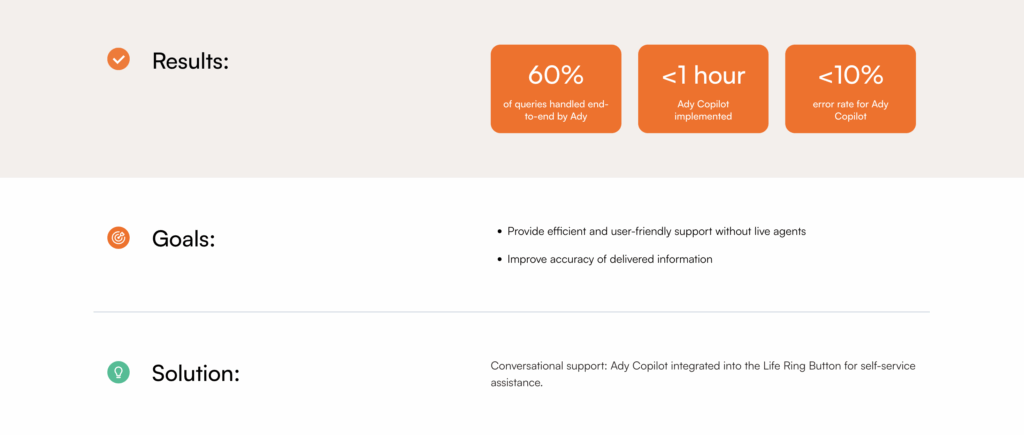
Adeus enhanced onboarding by adding a conversational support layer directly inside the Life Ring Button. They integrated Copilot (Ady), which connects to their internal knowledge base plus their website and blog to deliver precise, real‑time answers. Setup took under an hour, required no coding, and they used user feedback to continually improve responses. With Ady, Adeus now handles 50–60% of queries end‑to‑end, keeps errors under 10%, and onboards 70% of new users within 24 hours—reducing reliance on live agents while making users more autonomous.
3. AI Agents transform user adoption by creating onboarding flows that evolve with user behavior
Going in and building a one-size-fits-all onboarding flow is like going into a job interview without knowing anything about the company. You're flying blind.
AI agents create adaptive learning paths that change based on how users actually interact with your product. The agent learns from each interaction, continuously improving its responses and adapting to user feedback or product updates. Depending on user progress, it dynamically adjusts the onboarding curriculum by offering additional resources when users get stuck.
Think of it like a video game that adjusts difficulty based on your skill level. Struggling with a particular feature? The AI agent slows down, provides more context, maybe even offers a video tutorial. Breezing through? It accelerates, showing you advanced features you're ready for.
This matters because organizations that implement AI-driven customer onboarding see a 25% increase in cu.
4. AI Agents Transform SaaS User Adoption by creating a 24/7 Customer Success Team That Never Sleeps
Your human customer success team needs sleep. Coffee breaks. Weekends. Time zones are a thing. AI agents? They're the tireless workforce that's always ready.
Unlike human specialists, these digital teammates are available round the clock, providing instant support whenever a new user needs it. This is particularly crucial in today's global SaaS landscape where users span continents.
Picture a startup founder in Tokyo signing up for your product at 2 AM their time (which is 1 PM EST). With traditional onboarding, they'd hit a roadblock and have to wait hours for support. With an AI agent, they get instant, intelligent assistance that gets them up and running immediately.
AI-powered chatbots like Product Fruits’s Ady handle over 70% of customer questions across multiple channels and languages, making it a go-to tool for businesses aiming to streamline their support processes.
Companies applying AI in onboarding report a 20% reduction in onboarding time. When you multiply that time savings across thousands of users, you're talking about massive efficiency gains and cost reductions.
5. AI Agents Transform SaaS User Adoption by proactively solving user issues
So how can AI agents proactively solve user issues? Here's where AI agents become truly powerful: they're not just helping users - they're learning from every single interaction to make your entire product better.
By analyzing user interactions, these AI specialists can provide valuable feedback to product teams, driving continuous improvement. It collects and analyzes data from user interaction, giving valuable feedback to product teams that improves both the onboarding experience and the product. Think of it as having thousands of user researchers working simultaneously, identifying patterns you'd never spot manually:
- Which features confuse users most?
- Where do people get stuck in the onboarding flow?
- What questions come up repeatedly?
- Which user segments need different approaches?
This feedback loop is gold for product teams. The average time savings across all tasks when comparing the use of an AI agent vs manually completing the task was 66.8%, and that efficiency compounds as the system learns.
Can AI agents replace human customer success teams?
AI agents aren't replacing your customer success team—they're amplifying them.
About 71% of users prefer a human-in-the-loop setup, especially for high-stakes decisions, ensuring safety and accountability in AI-driven tasks. The smartest SaaS companies understand this.
As one VP of Customer Success explains: "If I have to interact with an AI all the time for software that I'm using, I don't necessarily mind that. But I'm not going to lunch with the AI. The human part is knowing that there are other humans inside of that organization who know about you and who are going to advocate for you."
Let AI handle what it does best. AI is unbeatable at processing huge quantities of data, generating routine content, and spotting patterns that humans might miss. Keep humans focused on human work.
Your team should spend their time on strategic decision-making, building relationships, and showing empathy.
The winning formula looks something like this - AI agents handle the repetitive, scalable tasks while humans focus on high-touch, strategic relationships. It's not AI versus humans - it's AI and humans working together.
How can SaaS companies start integrating AI agents into their workflows?
The trajectory is clear. Nearly 80% of organizations are using AI agents, and 96% plan to expand in 2025 with 33% of enterprise software applications expected to include agentic AI by 2028. Disruption is mandatory. Obsolescence is optional.
The SaaS companies winning in 2025 and beyond aren't treating AI agents as a nice-to-have feature. In 2025, AI-native products will have higher valuations and faster adoption curves.
If you're ready to integrate AI agents into your SaaS user adoption strategy, here's your action plan:
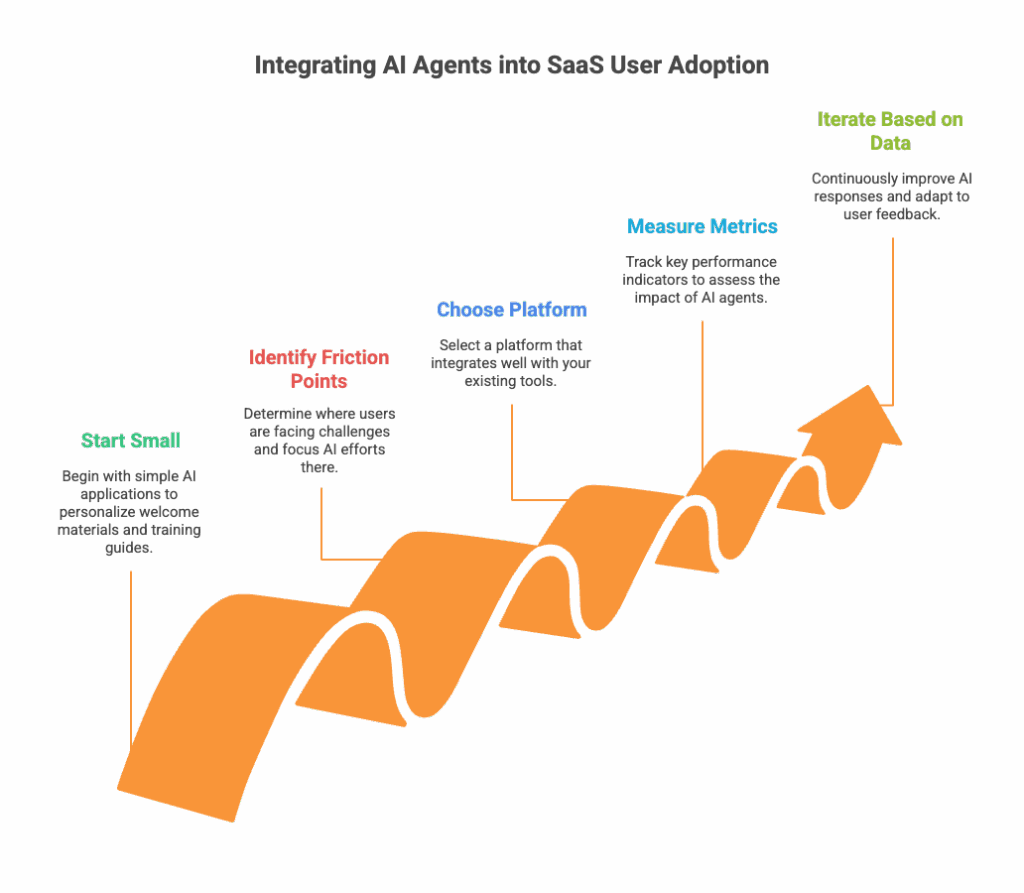
1. Start Small, Think Big
Don't try to automate everything at once. Start using AI to improve how you work with customers. Personalizing welcome materials and creating training guides are both good places to start. Consider experimenting with more advanced applications too, like AI agents and predictive analytics. Product Fruits can help you personalise your onboarding and get the ball rolling.
2. Identify Your Biggest Friction Points
Where are users getting stuck? What questions come up repeatedly? These pain points are your AI agent's first targets.
3. Choose the Right Platform
Look for solutions that integrate seamlessly with your existing stack. Tools like ProductFruits, Intercom Fin are all good starting points. Setup takes less than an hour. With ProductFruits, you can use AI agents for your onboarding, customer support right off the gate.
4. Measure What Matters
Track metrics like:
- Time to first value
- Onboarding completion rates
- Feature adoption rates
- Support ticket volume
- User satisfaction scores
Iterate Based on Data
The agent learns from each interaction, continuously improving its responses and adapting to user feedback or product updates. It collects and analyzes data from user interaction, giving valuable feedback to product teams that improves both the onboarding experience and the product.
AI agents aren't just optimizing user adoption—they're redefining what's possible. They're turning the traditional onboarding nightmare into a personalized, adaptive, always-on experience that scales effortlessly.
The question isn't whether AI agents will play a role in SaaS user adoption. They already are. The question is: Will you be leading this transformation or scrambling to catch up?
Your competitors are already implementing these systems. Every day you wait is another day of users abandoning onboarding flows, support tickets piling up, and revenue leaking out through churn.
Want to use AI agents that you can use for your customer onboarding and user adoption? Try your free trial here.


Weekly newsletter
Get the latest releases, tips, articles, and exclusive interviews delivered to your inbox weekly—no spam!