Product Fruits alternatives: an honest comparison of 7 onboarding tools


You are here because you are doing your homework. Smart. Before you commit budget to a product adoption platform, or renew one, it pays to know the field.
So here is the honest version. We make Product Fruits. We also know it is not the only good tool, and it is not the right fit for every team. This guide compares seven real alternatives, UserGuiding, Userpilot, Appcues, Chameleon, Pendo, Whatfix, and Userflow, with genuine pros, honest cons, real 2026 pricing, and a clear note on where each one leads. We will also be straight about where Product Fruits still wins, and where it does not.
By the end you will know which tool fits your team, your stack, and your budget. Including, possibly, the one you already have.
TL;DR: the 7 Product Fruits alternatives at a glance
- UserGuiding is best for budget-first teams getting started with basic onboarding.
- Userpilot is best for web-first teams that live in product analytics and experimentation.
- Appcues is best for polished, multi-channel experiments and native mobile onboarding.
- Chameleon is best for pixel-precise UI control and heavy A/B testing.
- Pendo is best for enterprise product analytics and cross-team governance. It genuinely leads on analytics depth.
- Whatfix is best for enterprise digital adoption and employee software training.
- Userflow (now part of Beamer) is best for tidy checklists and clean resource centers.
- Product Fruits is best for web-first SaaS teams that want AI support deflection, one no-code canvas to orchestrate onboarding flows, and transparent pricing without an enterprise contract.
The short read: most alternatives beat Product Fruits on one specific axis. Very few match its combination of included AI, all-in-one breadth, and a public pricing slider. That trade is the whole story below.
Ratings from G2 as of August 2026. Product Fruits also holds 4.7 on Capterra (89 reviews) and 4.6 on Gartner Peer Insights (22 reviews). Vendors change pricing and scores often, so always check the current pricing and review pages before you decide.
Why do teams look for Product Fruits alternatives?
Let's be honest about the real reasons, because pretending they do not exist helps no one.
Some teams need deeper analytics than any adoption tool provides on its own. If you want retroactive event tracking, funnels, and session replay as the center of your product decisions, you are looking at Pendo, and rightly so. Some teams need native mobile SDKs for a mobile-first app, where Appcues and Pendo are stronger than a web-first platform. Some enterprises need a digital adoption platform for internal software training and change management, which is Whatfix territory. And a few teams simply want the cheapest possible entry point to ship a first tour, which is where UserGuiding shines.
Those are legitimate reasons. We will point you to the right tool when one of them fits.
But here is the reframe worth sitting with. For most web-first SaaS teams under roughly 25,000 monthly active users, the reasons people cite for leaving, price at scale, a missing feature, a support gap, often do not survive contact with the actual math. Included AI, a transparent pricing slider, and an all-in-one platform frequently outweigh the one axis a competitor wins on. Before you migrate anything, it is worth knowing exactly what you would be giving up.
What you would be leaving behind: Product Fruits in 2026
Product Fruits changed a lot in 2026. If your mental model is "tours and tooltips," it is out of date. Four capabilities now define the platform, and most alternatives on this list do not match them in one included, no-code layer.
Flows. This is the big one. Flows is a visual canvas for guided experiences that react to what the user actually does. Unlike a linear tour that fires the same steps for everyone, a Flow can wait for a condition, branch into different paths, read and write user properties, call an API, and trigger actions like posting to Slack or sending an email. You build it by dragging steps onto a canvas: cards, conditions, delays, API calls, actions, and Elvin AI steps. A new admin sees one path. A trial user sees another. Someone who skips a step gets nudged back. And Record with Elvin lets you walk through your product while AI drafts the card copy from the page. It turns onboarding, in-app messaging, surveys, and support routing from four disconnected features into one connected system that a non-technical person can run. Appcues gates multi-channel messaging behind a paid add-on. Pendo's journey orchestration sits in its premium enterprise tier. In Product Fruits, this ships in the plan.
Annotations. This is a quietly clever feature. Annotations let you teach Elvin AI about your app's interface by clicking on elements, without writing a full knowledge base first. You annotate your critical user paths, partially or fully, and Elvin learns enough about your UI to generate interactive, on-the-fly product guides when a user asks a question. No documentation project required to get useful AI guidance. Most tools need a complete knowledge base before their AI can help. Annotations let Elvin start guiding from your interface itself.
Discoveries. Think of this as the LLM-powered successor to the static survey. Instead of firing the same fixed questions at everyone, you give Elvin a research objective and it runs a conversational interview that adapts in real time. Elvin asks one question at a time and follows up based on what each user actually says, digging deeper where it matters. Once you gather enough responses, it writes AI insight reports that synthesize the findings. A traditional survey gives you answers to the questions you thought to ask. Discoveries surfaces the ones you did not.
MCP. Product Fruits MCP connects your workspace to AI assistants like Claude, ChatGPT, Cursor, and Codex through the Model Context Protocol. You ask a plain-English question, such as "which step of my welcome flow loses the most users," and the assistant answers from live data: onboarding content, flow analytics and drop-off points, Discoveries, Elvin conversation summaries, knowledge base articles, and user activity. It signs in with OAuth rather than an API key, it is strictly read-only so nothing can be changed or deleted, and setup takes a few minutes. Most tools on this list do not offer anything comparable yet.
Add the parts that were already strong, the built-in Elvin AI assistant that resolves support questions from your content, tours, hints, checklists, announcements, in-app surveys, and a native knowledge base, and one number tells the story. Mystore, Norway's largest e-commerce platform, routes support through Elvin first and autonomously resolved close to 60% of inquiries within 90 days, with no added headcount (Mystore case study). That is the kind of result that is hard to walk away from.
And the pricing is public. The Product Fruits slider starts at $96 to $149 a month and scales with monthly active users, no sales call required. Reviewers rate it around 4.7 on G2 and 4.8 on Capterra.
How we evaluated these tools
Five criteria, weighted for a real buying decision:
- Ease and no-code control. Can a customer success or product marketing team ship guidance without engineering?
- Targeting and personalization. How precisely can you aim experiences, and can they adapt to behavior?
- Analytics depth. How much can you learn from the tool itself before you reach for a separate analytics stack?
- AI and automation. Does the AI do real work, support deflection, content generation, orchestration, or is it a demo feature?
- Pricing transparency. Can you see what you will pay at your MAU count without a sales call?
Yes, we build Product Fruits, so read this with healthy skepticism. We have tried to be fair enough that you would trust it even if we did not. Where a competitor wins, we say so.
1. UserGuiding
Best for: budget-first teams that want to ship basic onboarding cheaply.
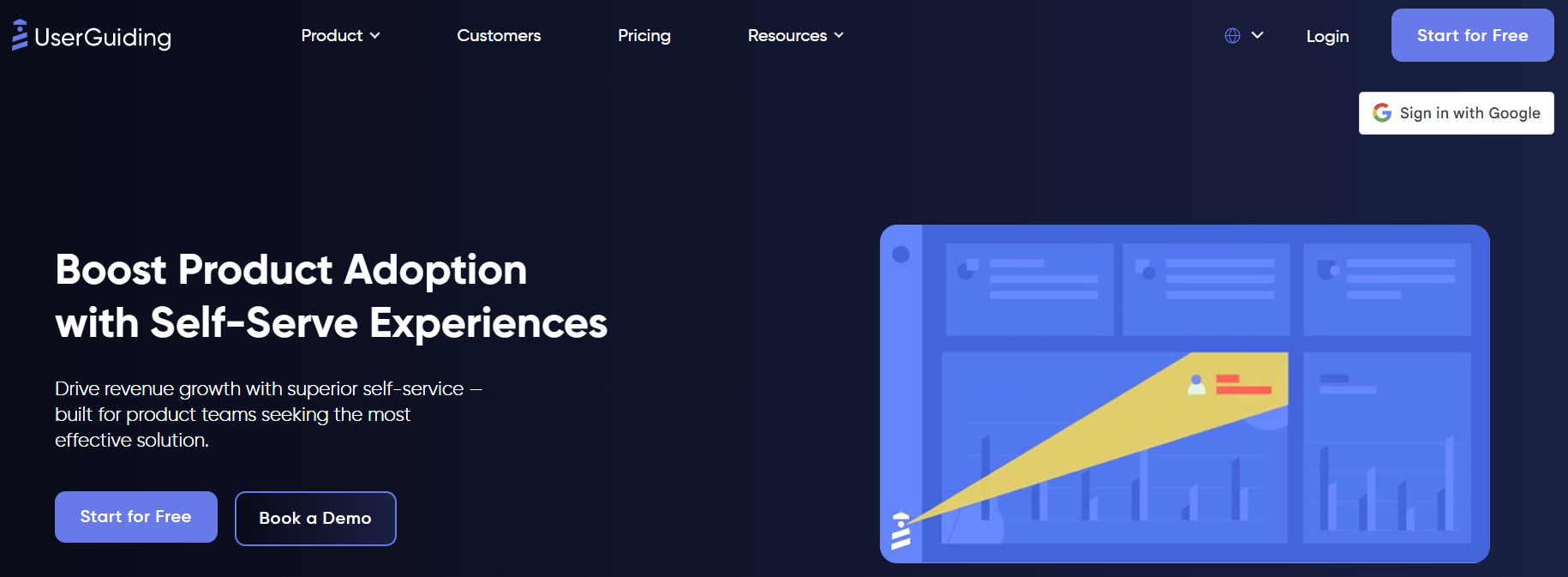
UserGuiding is the value entry point of the category. It offers a solid no-code builder, good templates, guides, checklists, and resource centers at a starting price well below most rivals, around $174 a month on annual billing. For a small team shipping its first onboarding flow, it does the job and does not overwhelm.
The honest cons: quotas. Guides, seats, and other limits are capped by tier, so costs and constraints appear as you scale. Its AI capabilities are lighter than the newer platforms, and analytics stay fairly surface-level.
Where Product Fruits wins: included AI does real work here. Elvin resolves support tickets, Annotations generate guidance from your UI, and Discoveries replaces static surveys, none of which UserGuiding matches. Product Fruits also avoids the quota ceilings on higher tiers and rates slightly higher with users (around 4.7 versus 4.6 on G2). If cheapest entry price is the only criterion, UserGuiding wins. If value at scale matters, look closely. We go deeper in our Product Fruits vs UserGuiding comparison.
2. Userpilot
Best for: web-first product teams that want analytics and experimentation at the center.
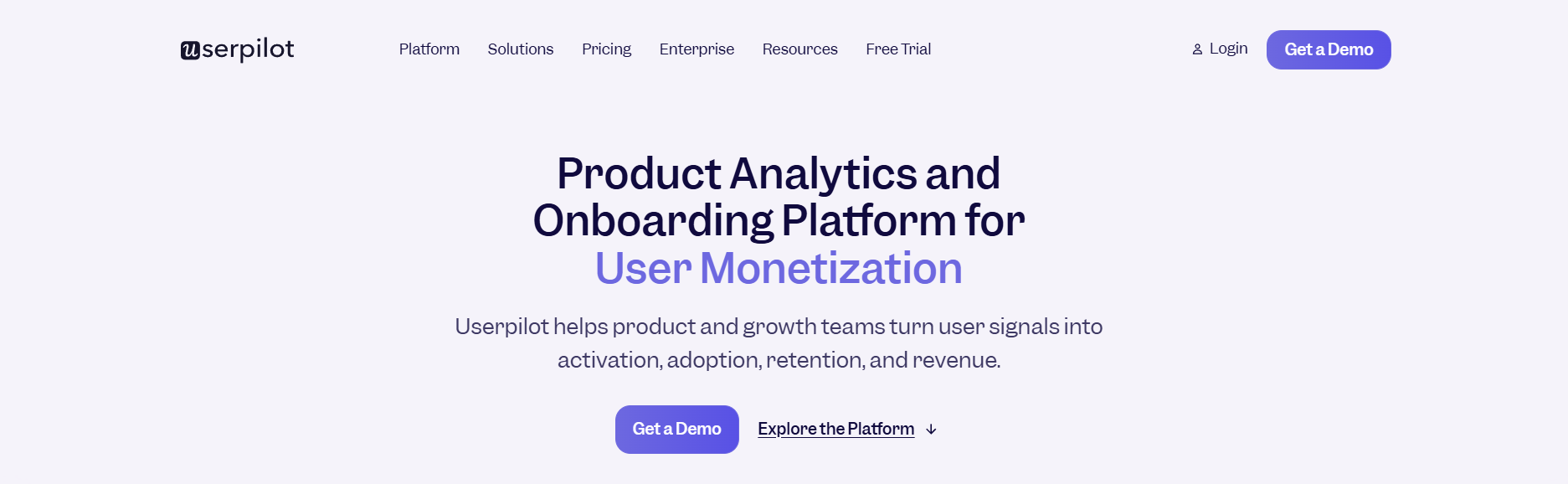
Userpilot pairs in-app guidance with strong product analytics, segmentation, and session replay. If your onboarding decisions are driven by funnels and A/B tests, it is a capable, mature choice. Its experimentation tooling is a genuine strength.
The honest cons: pricing starts around $299 a month and climbs with MAUs and features. The analytics-heavy surface area carries a learning curve, and support deflection is not its focus.
Where Product Fruits wins: price and AI-driven support. Product Fruits starts far lower on a transparent slider, includes Elvin AI support deflection and a native knowledge base rather than leaning on a separate help tool, and adds MCP so you can interrogate your onboarding data in plain English through Claude or ChatGPT. If deep product experimentation is your core job, Userpilot is strong. If activation plus support relief on a predictable budget is the goal, Product Fruits fits better.
3. Appcues
Best for: teams running frequent multi-channel experiments, including native mobile.
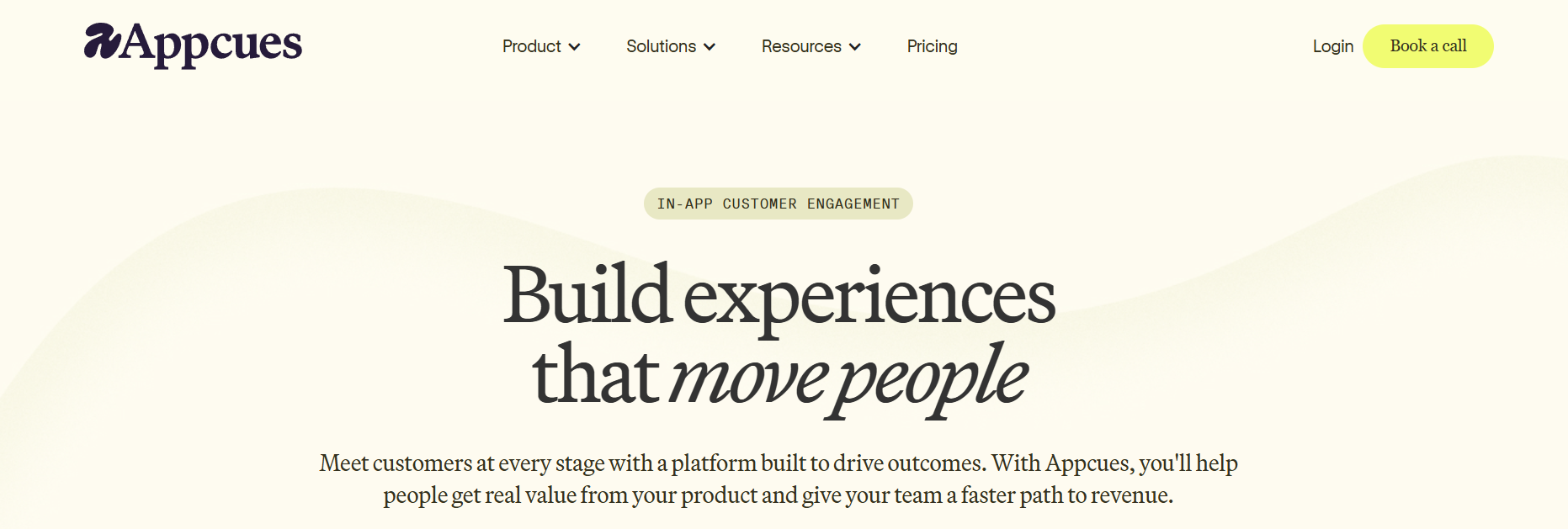
Appcues is the polished veteran. It has one of the widest ranges of no-code in-app patterns, native mobile SDKs, and a builder that reviewers consistently praise for ease of setup. If you ship onboarding across web and mobile and iterate constantly, it earns its reputation.
The honest cons: entry pricing starts around $249 a month on the Essentials plan and rises quickly, with higher tiers well into four figures monthly. And multi-channel messaging lives in the paid Connect add-on rather than the base plan.
Where Product Fruits wins: orchestration without the add-on. Flows connects onboarding, messaging, surveys, and support routing into one canvas that ships in the plan, where Appcues gates cross-channel messaging behind Connect. Elvin AI, Annotations, and Discoveries are included. Pricing is transparent and lower at the entry point. The fair concession: if you need first-class native mobile SDKs, Appcues (and Pendo) lead there, since Product Fruits is web-first. For a deeper look at cost, see our Product Fruits vs Appcues vs Pendo ROI comparison.
4. Chameleon
Best for: teams that want pixel-precise UI control and heavy experimentation.
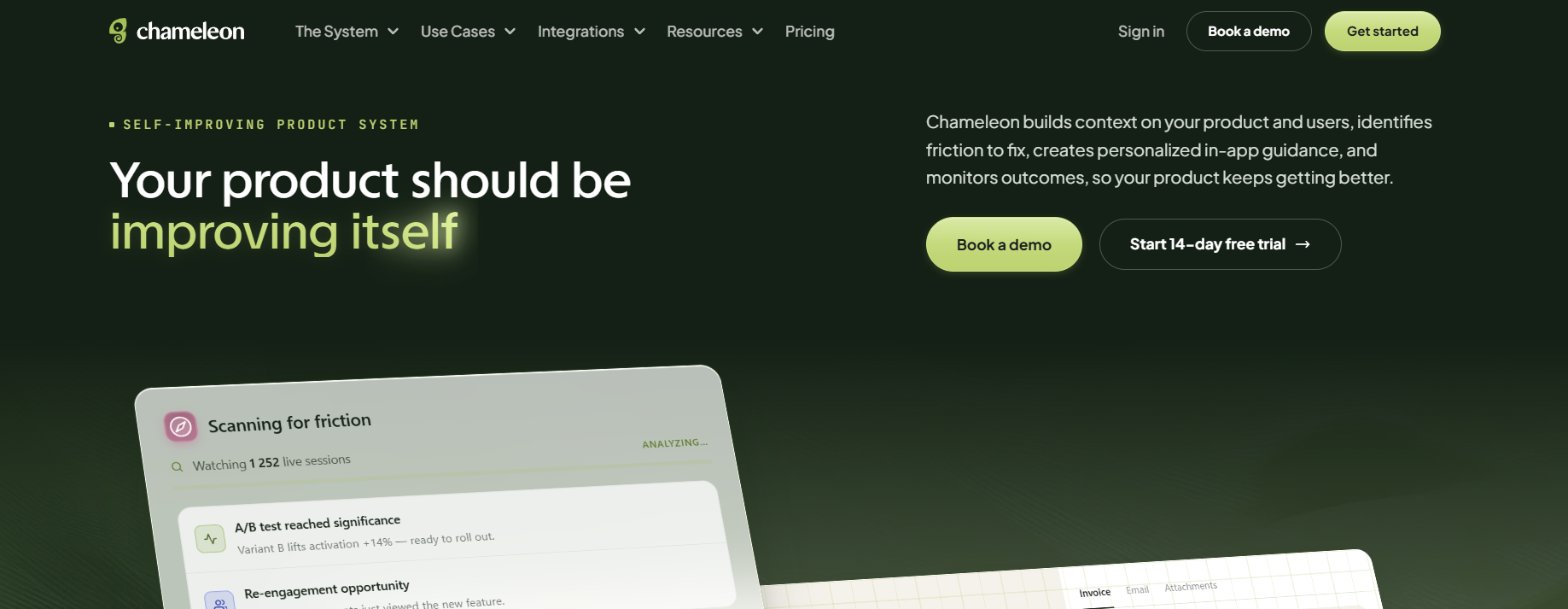
Chameleon gives designers and PMs granular control over how in-app experiences look and behave, with strong targeting and A/B testing. If matching your brand down to the pixel and testing variants is a priority, it is a serious option.
The honest cons: it sits at the premium end, starting around $279 a month, and its scope is narrower than an all-in-one suite. You may still need separate tools for surveys and a knowledge base.
Where Product Fruits wins: breadth and AI at a lower price. Product Fruits bundles Flows, tours, hints, checklists, announcements, in-app surveys, Discoveries, and a native knowledge base in one platform, with Elvin doing support and content work throughout. Chameleon wins on fine-grained UI craft. Product Fruits wins when you would rather run onboarding, feedback, and support from one no-code system.
5. Pendo
Best for: enterprises that want product analytics and governance at the center of everything.
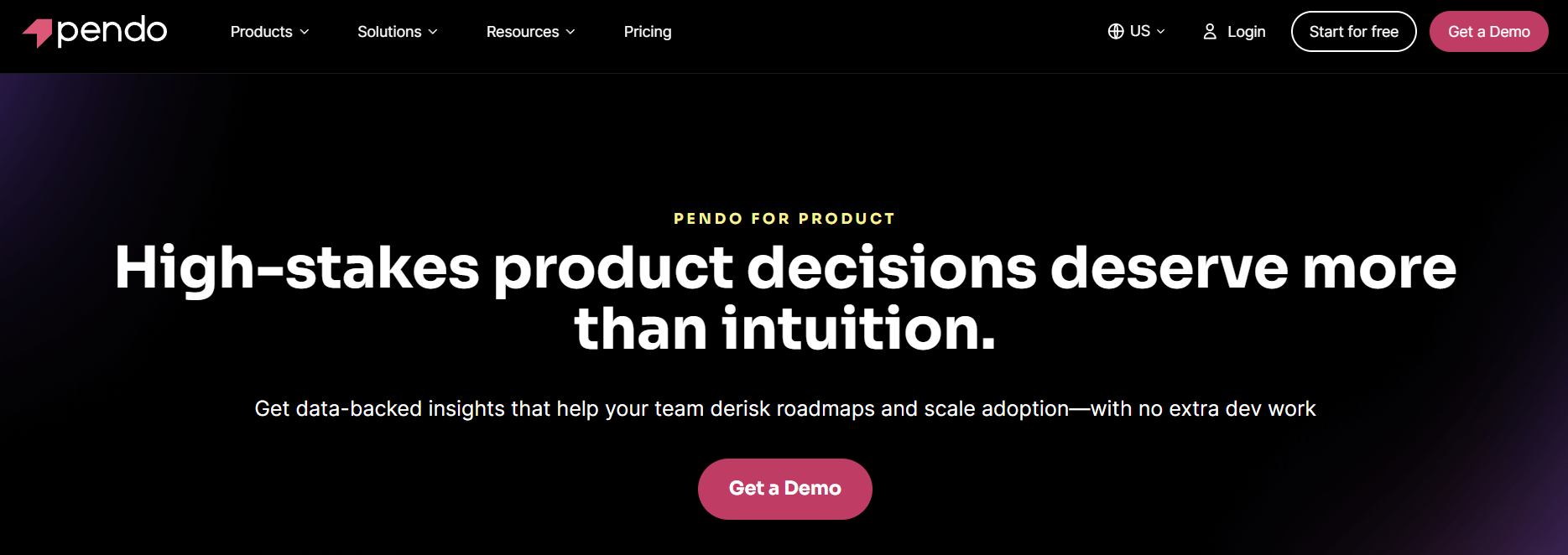
Let's give Pendo its due, because it genuinely leads on analytics. Retroactive event tracking, funnels, session replay, and its newer agentic AI insight layer make it the choice for large organizations that want data to drive every guidance decision, with governance across multiple products and teams. Nothing else on this list matches its analytical depth.
The honest cons: it is quote-only, with paid contracts commonly running five to six figures a year. Rollouts can take weeks to 90 days, it expects a level of analytics maturity to use well, and it has no native knowledge base, so you integrate an external one.
Where Product Fruits wins: transparent pricing, speed, and included AI. Many Product Fruits teams publish their first tours and checklists within hours, on public pricing, with Elvin resolving support questions from day one and a native knowledge base built in. And with MCP, you can point Claude or ChatGPT at your onboarding and Discoveries data for plain-English analysis without an enterprise analytics contract. If enterprise analytics is non-negotiable and funded, choose Pendo. If you want fast time to value and predictable cost, Product Fruits is the lighter, faster pick.
6. Whatfix
Best for: enterprises adopting a digital adoption platform for employee software and training.
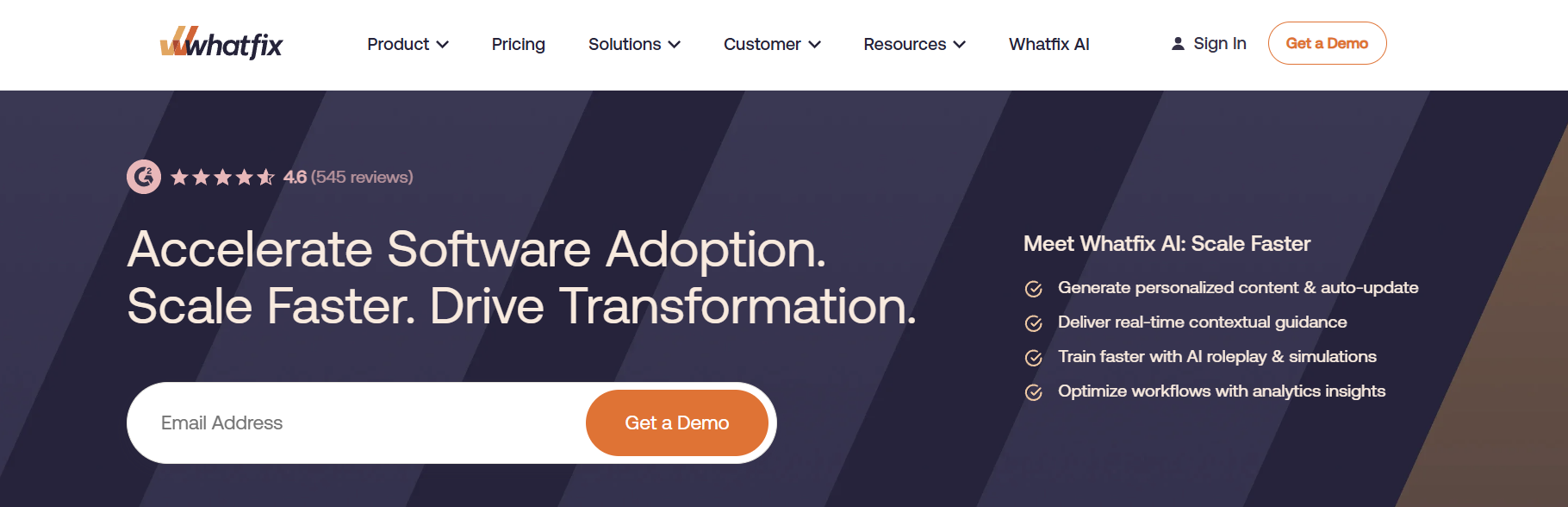
Whatfix is strong where the job is internal: driving adoption of enterprise software, building training content, and supporting change management across a workforce. It has a mature DAP feature set and content tooling that suits large IT and enablement teams.
The honest cons: it is enterprise-priced and quote-only, and its weight and complexity are overkill for a lean SaaS team focused on product-led onboarding for external users.
Where Product Fruits wins: product-led speed and transparent pricing. For a SaaS company onboarding customers (not employees) into a web app, Product Fruits is faster to deploy, no-code from end to end, and priced in the open. Whatfix wins for internal digital adoption at enterprise scale. Product Fruits wins for customer-facing SaaS onboarding.
7. Userflow (now part of Beamer)
Best for: teams that want clean checklists and tidy resource centers, fast.
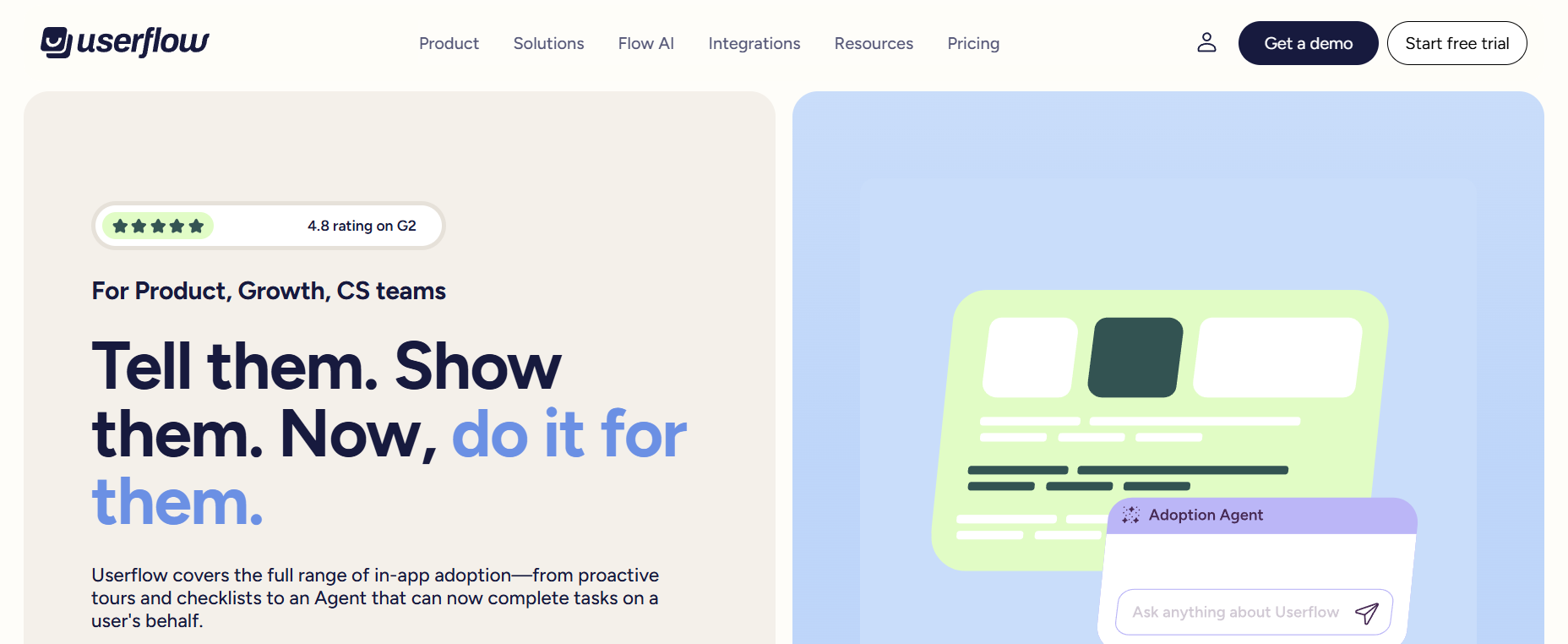
Userflow built a reputation for a clean, quick flow builder with well-designed checklists and resource centers. It is pleasant to use and gets simple onboarding live quickly. It is now part of Beamer, which broadens the surrounding toolkit.
The honest cons: post-acquisition roadmap direction is worth watching, and its AI and orchestration are lighter than the platforms investing heavily there.
Where Product Fruits wins: the 2026 AI and automation layer. Flows brings branching, property read/write, and integrations that go well beyond linear checklists. Annotations, Discoveries, and MCP add AI guidance, adaptive research, and LLM-powered analysis that Userflow does not match today. If you want a tidy checklist tool, Userflow is a fine choice. If you want an AI-forward adoption platform, Product Fruits is a step up.
So, should you actually switch?
Here is the decision framework, stated plainly.
Stay with Product Fruits if you are a web-first SaaS team that values fast time to value, AI support deflection, one no-code canvas to orchestrate onboarding and messaging, and transparent pricing. For most teams under roughly 25,000 MAUs, this is the sweet spot, and the included AI (Elvin, Annotations, Discoveries) plus MCP is hard to replicate by stitching together cheaper parts.
Consider Pendo if enterprise-grade product analytics, session replay, and cross-team governance are the point of the purchase, and you can fund the contract and the rollout.
Consider Appcues if native mobile SDKs and constant multi-channel experimentation are central, and the add-on model fits your budget.
Consider Whatfix if the job is internal employee software adoption and training rather than customer onboarding.
Consider UserGuiding if the only thing that matters is the lowest possible entry price for basic onboarding.
And to be fair about our own limits: Product Fruits is web-first, so a mobile-first app is better served elsewhere. Its built-in analytics are meant to optimize onboarding, not to replace a dedicated product analytics suite. If either of those is your primary need, a tool above may serve you better, and that is fine.
For most teams, though, the honest answer to "should I switch?" is: probably not, once you price out what you would be rebuilding.
Migrating to (or from) Product Fruits
If you are moving toward Product Fruits, migration is usually a one to three week project. Audit and map your existing flows, checklists, and resource-center items in week one. Rebuild key flows in the visual editor and point Elvin at your knowledge sources in weeks one to two. QA in staging, run both tools in parallel with a small cohort, then cut over. Most teams report faster setup than their original implementation, partly because Flows and Elvin remove work that used to need engineering.
If you are evaluating away from Product Fruits, the same map works in reverse, and knowing the effort involved is exactly why it is worth confirming the gap is real before you start.
FAQ
What is the best Product Fruits alternative?
There is no single best alternative. It depends on your need. Pendo leads for enterprise analytics, Appcues for native mobile and multi-channel experiments, UserGuiding for lowest entry price, and Userpilot for web analytics. For most web-first SaaS teams, though, the trade-offs (price, included AI, all-in-one breadth) tend to favor staying with Product Fruits.
Is there a cheaper alternative to Product Fruits?
UserGuiding has a lower entry price, starting around $174 a month. But cheaper entry often means quota caps and lighter AI. Product Fruits starts at $96 to $149 a month on a transparent slider and includes Elvin AI support deflection, Annotations, Discoveries, and a native knowledge base, so the value comparison is closer than the sticker price suggests.
What is the difference between Product Fruits and Userpilot?
Userpilot centers on product analytics and experimentation, with pricing from around $299 a month. Product Fruits centers on AI-assisted adoption: Elvin support deflection, Flows orchestration, and a native knowledge base, on a lower, transparent slider. Choose Userpilot for deep experimentation, Product Fruits for activation plus support relief on a predictable budget.
Do Product Fruits alternatives include AI support deflection?
Most do not include it in the base plan. Several offer AI for content generation, but built-in support deflection that answers users from your own content is less common. Product Fruits includes the Elvin AI assistant, and customers like Mystore resolve close to 60% of support inquiries autonomously after tuning it.
Which onboarding tool has the best analytics?
Pendo, clearly. It offers retroactive event tracking, funnels, session replay, and predictive AI insights natively. Userpilot is strong on web analytics. Product Fruits provides built-in flow analytics to optimize onboarding and, via MCP, lets you analyze that data through Claude or ChatGPT, while pairing with your existing analytics stack for deeper behavioral work.
How hard is it to switch onboarding tools?
Usually one to three weeks. Export and map your existing flows, checklists, and resource center, rebuild the key experiences in the new tool, connect your segments and knowledge sources, then run both in parallel with a small cohort before cutting over. Teams often find rebuilding faster than the original setup.
What are Product Fruits Flows?
Flows is a no-code visual canvas for guided experiences that adapt to user behavior. Unlike a linear tour, a Flow can branch, wait for conditions, read and write user properties, call APIs, and trigger actions like Slack messages. It connects onboarding, messaging, surveys, and support into one automated system, and Record with Elvin drafts the copy for you.
The bottom line
There is no universal best product adoption tool, only the best one for your MAUs, your stack, and your priorities. Pendo earns its cost when enterprise analytics are non-negotiable. Appcues wins on native mobile and multi-channel breadth. UserGuiding wins on entry price. But for most web-first SaaS teams, the combination that is genuinely hard to replace, Elvin AI support deflection, Flows orchestration in one no-code canvas, Annotations, Discoveries, MCP, and a transparent pricing slider, is exactly what Product Fruits ships today. Before you switch, it is worth seeing what that looks like on your own product and MAU count. Try Product Fruits for free or Book a demo and we will show you.


Weekly newsletter
Get the latest releases, tips, articles, and exclusive interviews delivered to your inbox weekly—no spam!