AI Agent Tools to Boost Product Adoption: Complete Recommendations Guide


AI agent tools that boost product adoption include Product Fruits with Elvin AI for automated personalized onboarding, conversational AI platforms for instant support, behavioral analytics tools for identifying adoption patterns, and integration platforms for connecting data across systems. Product Fruits delivers the strongest results by combining AI-generated onboarding (64% activation rate) with Elvin Copilot for conversational support (25-30% support ticket reduction) in a single platform, eliminating the need for separate tools and complex integrations.
Product adoption determines SaaS success. Users who activate quickly stay longer, expand usage, and refer others. Users who struggle churn before experiencing value. AI agent tools address adoption at scale without proportional increases in human resources.
TLDR: AI Agent Tool Recommendations to increase product adoption rates:
- For most SaaS companies: Product Fruits delivers the best combination of capabilities, results, and value. The integrated platform addresses onboarding, support, and analytics in one system. AI-powered personalization eliminates manual work. Proven results with 64% activation rates and 25-30% support deflection.
- For support-focused companies already using Intercom: Add Fin AI to existing Intercom subscription. Good conversational support but requires separate onboarding tools.
- For enterprise companies with analytics needs: Consider Pendo for comprehensive product analytics alongside guidance tools. Be prepared for complex implementation and enterprise pricing.
- For teams with substantial development resources: Evaluate custom builds only if truly unique requirements exist that platforms can't meet. Most teams overestimate uniqueness.
- For behavioral insights: Add Amplitude to any adoption platform for deep usage analysis. Use insights to optimize AI agent behavior.
The AI agent market continues evolving rapidly. Platform capabilities improve continuously. Custom builds risk obsolescence as platforms add features. Starting with proven platforms makes sense for most teams.
Explore different implementation approaches through use cases. Review what to know before buying or compare AI agent solutions.
Ready to boost product adoption with AI agent tools? Use Product Fruits and let Elvin AI personalize onboarding automatically while Elvin Copilot provides instant support. See implementation guide or review user onboarding software comparison.
What Are AI Agent Tools for Product Adoption?
AI agent tools use artificial intelligence to guide users through products, answer questions, and adapt guidance based on behavior. These tools operate autonomously, making intelligent decisions about what help each user needs without requiring manual configuration for every scenario.
Core categories of AI adoption tools:
Onboarding AI generates personalized product tours and guidance automatically based on user attributes and behavior. Product Fruits' Elvin AI exemplifies this category.
Conversational AI answers user questions through natural language interaction. Users ask questions in their own words and receive immediate, specific answers.
Behavioral AI watches what users do and adapts guidance accordingly. Users moving quickly get advanced features sooner. Users struggling get additional help proactively.
Predictive AI identifies patterns indicating expansion opportunities or churn risks. Teams can intervene before users abandon products.
Analytics AI processes usage data to reveal insights about adoption patterns, friction points, and optimization opportunities.
These categories often overlap. Comprehensive platforms like Product Fruits combine multiple AI capabilities in one system.
Top AI Agent Tools that increase product adoption rates:
Best Overall: Product Fruits
Product Fruits combines AI-powered onboarding, conversational support, and behavioral adaptation in one comprehensive platform. This integrated approach addresses all aspects of product adoption through AI.
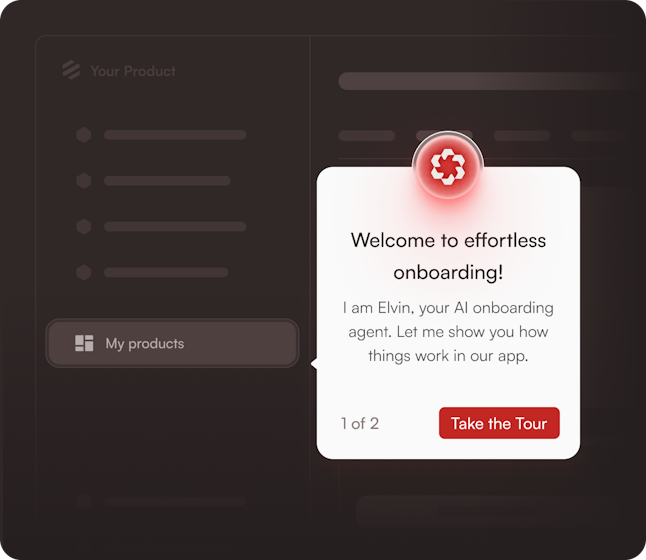
AI capabilities:
- Elvin AI generates personalized onboarding automatically for each user segment
- Elvin Copilot provides conversational support from knowledge base
- Behavioral triggers surface relevant features at optimal moments
- Onboarding checklists guide users through activation steps
- Real-time adaptation adjusts guidance based on user actions
- Analytics identify adoption patterns and friction points
Why it boosts adoption:
- 64% average activation rate versus 25% industry standard
- Personalization happens automatically without manual building
- Instant answers prevent users from getting stuck
- Continuous engagement drives feature discovery
- All capabilities in one platform avoid integration complexity
Results:
- Keboola accelerated onboarding by 29%
- FitnessPlayer reduced churn by 70%
- Chemsoft cut support tickets by 30%
- Adeus delivers 24/7 support without overnight staff
Pricing: $96/month for full platform with unlimited AI usage.
Best for: SaaS companies wanting comprehensive AI adoption tools in one platform. Teams that value implementation speed and proven results.
Implementation: 1-2 weeks from purchase to live. See how it works for details.
Best for Conversational Support: Intercom with Fin AI
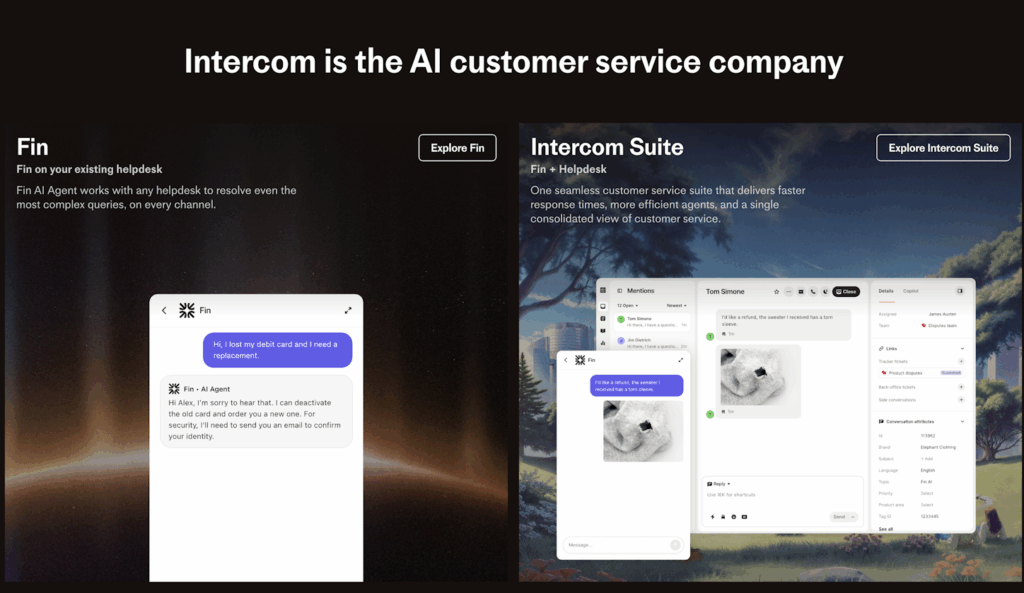
Intercom's Fin AI adds conversational capabilities to their established messaging platform. The AI answers customer questions from help articles and routes complex issues to human agents.
AI capabilities:
- Natural language understanding for questions
- Answers generated from help documentation
- Seamless handoff to human agents
- Conversation routing based on complexity
- Multi-language support
Why it boosts adoption:
- Instant answers reduce support friction
- 24/7 availability helps global users
- Reduces support costs while maintaining quality
- Integrates with existing Intercom messaging
Limitations: Requires existing Intercom subscription. Doesn't include onboarding tools. Per-resolution pricing can escalate costs. Need separate platform for product tours.
Pricing: Base Intercom subscription plus approximately $0.99 per AI resolution.
Best for: Companies already using Intercom for customer messaging. Support-focused teams not needing onboarding capabilities.
Best for Enterprise Analytics: Pendo with Guide AI
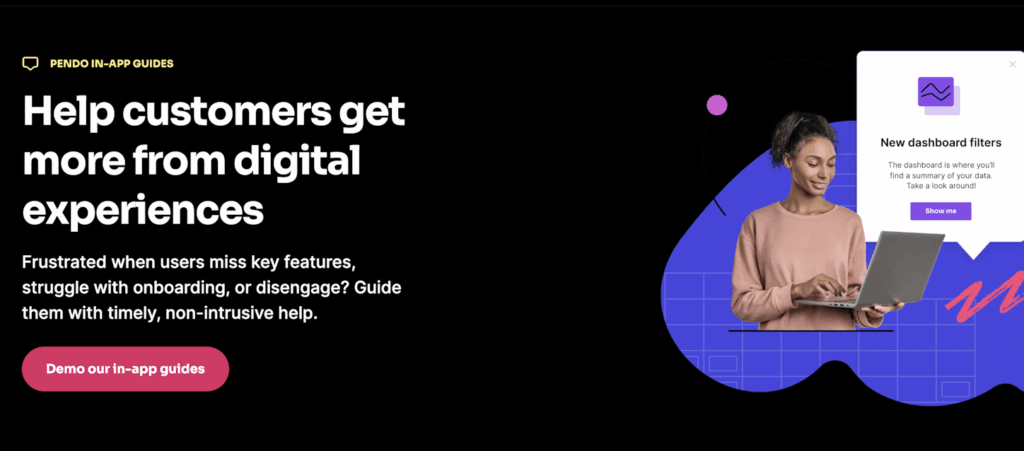
Pendo combines comprehensive product analytics with AI-enhanced guidance. The platform targets enterprise customers needing deep usage insights alongside adoption tools.
AI capabilities:
- Predictive analytics identifying at-risk users
- AI-suggested interventions based on behavior patterns
- Automated segmentation finding user clusters
- Sentiment analysis from feedback
- Usage pattern recognition
Why it boosts adoption:
- Data reveals exactly where users struggle
- Predictive models identify expansion opportunities
- AI surfaces insights human analysts might miss
- Enterprise-scale analytics infrastructure
Limitations: Complex implementation (4-8 weeks typical). Enterprise pricing restricts smaller teams. AI features less advanced than pure-play AI platforms. Steep learning curve.
Pricing: Custom enterprise pricing, typically $20,000+ annually.
Best for: Enterprise SaaS companies with dedicated product teams needing comprehensive analytics alongside guidance tools.
Best Budget Option: ChatGPT API Integration
Technical teams can build custom adoption AI using OpenAI's ChatGPT API integrated with existing onboarding tools and documentation.
AI capabilities:
- Powerful natural language understanding
- Conversational responses to user questions
- Learns from provided documentation
- Customizable behavior through prompts
- Integration flexibility
Why it boosts adoption:
- Extremely low per-use costs once implemented
- Complete control over AI behavior
- Can integrate with any existing tools
- Powerful language model capabilities
Limitations: Requires substantial development work ($10,000-$20,000 initial investment). Ongoing maintenance needed. Must build UI, integration, and analytics yourself. Hidden costs in engineering time often exceed platform costs.
Pricing: API costs approximately $0.001-$0.002 per conversation. Development costs $10,000-$20,000 initially plus ongoing maintenance.
Best for: Technical teams with excess development capacity. Companies with unique requirements that platforms can't meet.
Best for Behavioral Triggers: Amplitude with Recommend
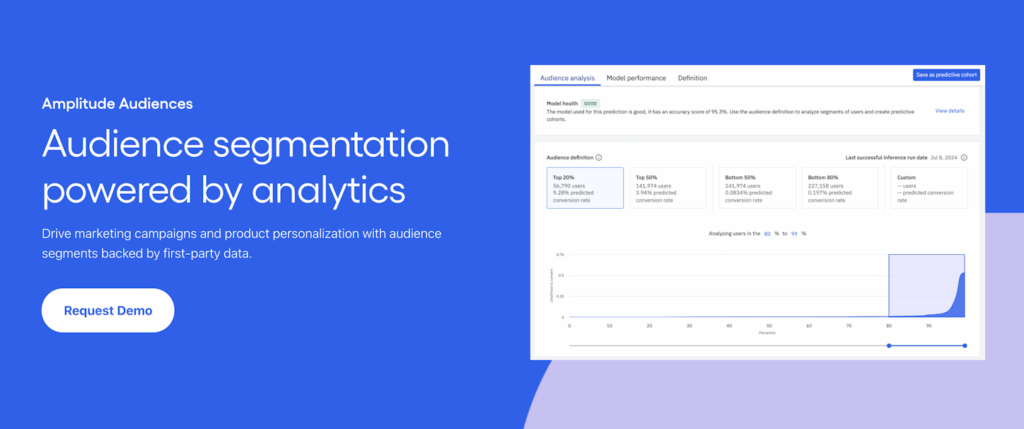
Amplitude's Recommend feature uses AI to identify optimal times for feature suggestions and interventions based on behavioral patterns.
AI capabilities:
- Behavioral pattern recognition
- Optimal timing prediction for interventions
- Cohort analysis powered by machine learning
- Feature adoption prediction
- Churn risk scoring
Why it boosts adoption:
- Data-driven timing for feature discovery
- Personalized recommendations based on behavior
- Predictive models identify expansion opportunities
- Comprehensive funnel analysis
Limitations: Analytics-focused rather than action-focused. Requires separate tools for actual user guidance. Complex to implement properly. Primarily serves data teams rather than product teams directly.
Pricing: Starts free for basic analytics. Growth plans scale with event volume. Recommend features on higher tiers.
Best for: Product-led companies with strong analytics teams. Organizations wanting behavioral insights to inform manual interventions.
Which AI Agent Tool Should you choose to increase product adoption rates?
Based on Primary Need
Choose Product Fruits if:
- Need comprehensive adoption solution (onboarding + support + analytics)
- Want AI to handle personalization automatically
- Prefer integrated platform over multiple tools
- Value fast implementation (1-2 weeks)
- Budget allows $96 monthly
Choose Intercom if:
- Already using Intercom for messaging
- Support-focused rather than onboarding-focused
- Willing to pay per-resolution pricing
- Need deep messaging capabilities
- Don't need product tours
Choose Pendo if:
- Enterprise requirements (SSO, compliance, etc.)
- Analytics depth critical priority
- Budget supports $20,000+ annually
- Large product team exists
- Can handle 4-8 week implementation
Choose custom development if:
- Budget exceeds $100,000 for this project
- Have AI engineering resources available
- Unique requirements platforms can't meet
- Timeline allows 6-12 months development
- Control outweighs cost and time
Choose Amplitude if:
- Strong analytics team exists
- Behavioral insights more important than automated action
- Already using Amplitude for analytics
- Can build intervention tools separately
- Analytics-driven culture
Based on Company Stage
Pre-Seed and Seed Stage:
Primary needs: Fast results, clear ROI, simple implementation, affordable pricing.
Recommendation: Product Fruits delivers comprehensive capabilities at startup-friendly pricing. Implementation speed crucial at this stage. Can't afford 3+ month implementations or $20,000+ annual costs.
Alternative: If budget extremely constrained, delay AI adoption until reaching sustainable revenue. Focus on manual onboarding until affording proper tools.
Series A Stage:
Primary needs: Scalable personalization, proven results, professional support, reasonable pricing.
Recommendation: Product Fruits for most companies. AI personalization scales with growth. Pricing remains predictable. Results show clearly in first quarter.
Alternative: Intercom if already using their platform and support-focused. Pendo if analytics depth critical and budget supports enterprise pricing.
Series B+ Stage:
Primary needs: Enterprise features, security compliance, advanced capabilities, dedicated support.
Recommendation: Product Fruits scales into enterprise successfully. Add Amplitude for deep behavioral analytics if needed.
Alternative: Pendo for companies needing comprehensive analytics platform. Custom development for unique requirements justifying investment.
Based on Technical Resources
Limited technical resources (small engineering team):
Recommendation: Product Fruits or Intercom. Both implement quickly with minimal engineering involvement. Ongoing maintenance minimal.
Avoid: Custom builds, complex integrations, platforms requiring substantial technical configuration.
Moderate technical resources (dedicated product team):
Recommendation: Product Fruits for implementation speed, or Pendo if analytics depth worth the complexity. Can handle more sophisticated platforms.
Consider: Custom integrations between best-of-breed tools if specific needs justify complexity.
Extensive technical resources (large engineering team with AI expertise):
Recommendation: Still consider platforms first for speed and proven results. Custom builds only if truly unique requirements exist.
Consider: Building custom AI on top of platform APIs for specific advanced capabilities.
Implementation Recommendations
Phase 1: Foundation (Week 1)
Start with technical infrastructure and data preparation.
Tasks:
- Install AI agent platform (Product Fruits snippet installation takes 2-4 hours)
- Configure user attribute passing from your application
- Set up integrations with analytics platforms
- Organize help documentation for AI to access
- Define user segments and critical activation actions
Deliverable: Technical foundation ready for AI configuration.
Common mistakes: Rushing through documentation organization. Poor documentation produces poor AI answers. Invest time here.
Phase 2: AI Configuration (Week 2)
Configure the AI agent for your specific product and users.
Tasks:
- Annotate product interface using visual editor
- Define personalization rules for different segments
- Configure behavioral triggers for feature discovery
- Set up conversational AI with knowledge base
- Create onboarding checklists tracking activation
Deliverable: AI agent configured and ready for testing.
Product Fruits advantage: Elvin AI generates onboarding automatically from annotations. Other platforms require manually building tours for each segment.
Phase 3: Testing (Week 3)
Test thoroughly before launching to all users.
Tasks:
- Internal team testing across different user roles
- Pilot with 5-10% of actual new users
- Collect feedback and identify issues
- Verify analytics tracking correctly
- Refine AI responses and flows
Deliverable: Validated AI agent ready for full launch.
Testing tip: Test with people unfamiliar with your product. Team members know the product too well to identify confusion points.
Phase 4: Launch (Week 4)
Roll out to all users and monitor results.
Tasks:
- Enable for 100% of new signups
- Monitor activation rates daily
- Track support ticket volume changes
- Gather user feedback continuously
- Make initial optimizations based on data
Deliverable: Fully operational AI agent improving adoption.
Measurement: Product Fruits customers typically see activation improvements within first 30 days. Keboola achieved 29% faster onboarding in first month.
Ongoing Optimization
AI agents improve over time through continuous optimization.
Monthly activities:
- Review activation rates by segment
- Analyze drop-off points in onboarding
- Update documentation as product changes
- Refine behavioral triggers based on results
- Test new personalization approaches
Quarterly activities:
- Major content refresh
- User interview insights incorporated
- New feature onboarding added
- Pricing or positioning changes reflected
- A/B test major changes to flows
Product Fruits' AI adapts automatically to product changes. Manual platforms require updating every tour when UI changes.
How do you measure the Impact of AI Agents on your product
Primary Adoption Metrics
Activation rate: Percentage of signups completing meaningful first action. Product Fruits customers average 64% versus 25% industry standard.
Time to first value: How long from signup to first success. Keboola reduced this by 29% using AI-powered onboarding.
Feature adoption rate: Percentage of users adopting key features. AI-driven feature discovery increases this 30-40%.
Completion rate: Percentage of users completing onboarding flows. Well-designed AI guidance achieves 60-80% completion.
Secondary Impact Metrics
Support ticket volume: AI conversational support deflects 25-30% of tickets. Chemsoft cut tickets 30% with Elvin Copilot.
Support response time: From hours to instant with AI. Adeus delivers 24/7 support using conversational AI.
User satisfaction: NPS typically improves 10-20 points with better onboarding and instant support.
Retention rate: Better activation predicts better retention. FitnessPlayer reduced churn 70% with AI adoption tools.
Business Impact Metrics
Customer acquisition cost efficiency: More activated users means lower effective CAC. Same acquisition spend produces more successful customers.
Customer lifetime value: Better-activated users stay longer and expand usage. LTV improvements of 25-50% common.
Net revenue retention: Companies with AI adoption tools achieve 120-130% NRR versus 100-110% without.
Expansion revenue: Users adopting more features expand contracts. AI feature discovery drives 30-40% higher expansion.
Track these metrics before and after AI implementation. Clear measurement demonstrates ROI and justifies continued investment.
Common Mistakes to avoid when choosing an AI Agent Tool to increase product adoption rates.
Buying Tools Without Strategy
AI agents implement strategies but don't create them. Define clear adoption goals before buying tools.
Strategic questions:
- What specific activation rate are we targeting?
- Which user segments need most improvement?
- What are our top 3 onboarding friction points?
- How will we measure success?
- What will we do differently once AI handles routine work?
Tools enable strategies. Start with strategy, then select tools that implement it.
Expecting Immediate Perfection
AI agents improve over time. Initial results typically good but not perfect. Continuous optimization drives excellence.
Reality:
- Week 1: Learning curve as team gets comfortable
- Month 1: Clear improvements visible in metrics
- Month 3: Substantial gains as AI learns patterns
- Month 6: Excellent results as optimization compounds
Product Fruits shows results quickly but improves continuously. FitnessPlayer's 70% churn reduction emerged over several months.
Under-Investing in Documentation
AI conversational support is only as good as the documentation it accesses. Poor documentation produces poor answers.
Documentation investment:
- Initial cleanup: 20-40 hours organizing existing content
- Ongoing maintenance: 5-10 hours monthly keeping current
- Quality improvement: Regular review and enhancement
This investment pays off regardless of AI tool choice. Good documentation helps users through any interface.
Neglecting Change Management
AI tools change how teams work. Address organizational change explicitly.
Change considerations:
- How will product team roles shift?
- What happens to support team capacity freed by AI?
- Who owns AI agent optimization?
- How will success metrics change?
- What training does team need?
Successful implementations include change management. Teams understand new workflows and embrace AI augmentation.
Treating AI as Set-and-Forget
AI agents require ongoing attention despite automation benefits. Regular review and optimization drive best results.
Maintenance activities:
- Weekly metrics review
- Monthly optimization sessions
- Quarterly major updates
- Continuous documentation improvements
- Regular user feedback collection
Product Fruits requires minimal maintenance compared to manual tools, but best results come from active optimization.
Advanced AI Agent Strategies
Multi-Channel Adoption
Use AI agents across all user touchpoints for consistent experience.
Touchpoints:
- In-product guidance through tours and tooltips
- Conversational support through AI copilot
- Email sequences triggered by AI-identified patterns
- In-app announcements for feature discovery
- SMS or push notifications for re-engagement
Product Fruits handles in-product channels natively. Integrate with email and communication tools for multi-channel strategies.
Predictive Intervention
Use AI to identify users likely to churn and intervene proactively.
Signals:
- Declining usage frequency
- Abandoned onboarding flows
- Feature adoption below segment averages
- Increasing support tickets
- Negative sentiment in feedback
Intervene before users decide to churn. AI identifies patterns early enough for successful intervention.
Expansion Optimization
Use AI to identify expansion opportunities based on usage patterns.
Expansion signals:
- Power user behaviors
- Feature adoption suggesting higher-tier needs
- Team growth patterns
- Integration usage indicating depth
- API usage approaching limits
Product Fruits identifies these patterns. Customer success teams can reach out proactively with relevant expansion offers.
Competitive Displacement
Use AI adoption excellence to displace competitors through superior onboarding.
Strategy:
- Activate users faster than competitors can
- Provide instant support while competitors make users wait
- Surface features competitors don't have
- Create habits before users try alternatives
- Make switching costs psychological through product excellence
Product adoption becomes competitive advantage. AI tools enable adoption excellence at scale.
Integration Recommendations
Analytics Integration
Connect AI adoption tools to analytics platforms for unified data.
Primary integrations:
- Segment for event streaming
- Mixpanel or Amplitude for behavioral analysis
- Google Analytics for web tracking
- Data warehouses for deep analysis
Product Fruits integrates with all major platforms. Adoption events flow into existing analytics automatically.
CRM Integration
Connect adoption data to sales and customer success tools.
Key integrations:
- HubSpot for SMB and mid-market
- Salesforce for enterprise
- Pipedrive for sales-focused teams
Adoption data informs customer success outreach. Teams see which accounts activate well and which need attention.
Support Integration
Connect AI support to human support for seamless escalation.
Essential integrations:
- Intercom for live chat escalation
- Zendesk for ticket management
- Help Scout for email support
Product Fruits' Elvin Copilot handles routine questions. Complex issues escalate to human support automatically with full context.
Communication Integration
Connect AI insights to team communication tools.
Useful integrations:
- Slack for team notifications
- Microsoft Teams for enterprise
- Email for automated workflows
Notify teams when important adoption events occur. High-value accounts activating, at-risk users declining, or anomalies detected trigger appropriate alerts.


Weekly newsletter
Get the latest releases, tips, articles, and exclusive interviews delivered to your inbox weekly—no spam!