How to Use AI for Product Adoption: The Complete 2026 Guide


Picture this: You've spent six months building the perfect feature. Your team has poured everything into it. Launch day arrives, and... crickets. Two weeks later, your analytics show a devastating 8% adoption rate. Your CEO is asking questions. Your team is demoralized. And you're staring at dashboards wondering what went wrong.
Sound familiar? You're not alone. The average SaaS product sees only 10-20% of users actually adopt new features. But here's what's changed: AI isn't just making product adoption easier - it's completely rewriting the playbook for user onboarding and the entire product adoption lifecycle.
What Is Product Adoption (And Why Most Companies Get It Wrong)
Product adoption is the journey from a user signing up to actually getting meaningful value from your product. It's not about downloads or sign-ups - it's about active, engaged users who integrate your product into their daily workflow.
70% of SaaS products fail due to poor user adoption, not because they're bad products. Think about that. Most products don't fail because of technical flaws or market fit. They fail because users never learn how to use them properly.
The traditional approach to product adoption looks like this:
- Generic onboarding flows that everyone sees
- Static tooltips that interrupt at the wrong moments
- Help documentation nobody reads
- Support tickets piling up about the same basic questions
- Product managers guessing what users need based on limited data
It's like trying to teach a cooking class where everyone gets the exact same recipe, regardless of whether they're a beginner or a Michelin-star chef. The beginners are overwhelmed. The experts are bored. Nobody's satisfied.
The best personalized onboarding experiences adapt to each user's needs, not force everyone through the same rigid path.
Why AI Changes Everything About Product Adoption
Here's where it gets interesting. Imagine knowing exactly what each user needs to learn, precisely when they need to learn it, and delivering that guidance in a way that feels natural - not intrusive.
That's what AI makes possible.
Traditional product adoption is reactive and generic. AI-powered product adoption is predictive and personal. The difference? A user who's about to churn gets proactive help before they even realize they're struggling. A power user gets advanced tips instead of basic tutorials. A non-technical user gets extra hand-holding automatically.
Companies using AI for product adoption are seeing 3-4x higher feature adoption rates and 40-60% reduction in time-to-value. Why? Because AI does three things humans simply can't do at scale:
- It processes signals in real-time - Mouse hesitations, repeated clicks, navigation patterns, session duration changes
- It personalizes at the individual level - Not segments, not cohorts, but truly individual user paths
- It predicts problems before they happen - Spotting "I'm about to give up" patterns milliseconds before the user rage-quits
Why Companies MUST Use AI for Product Adoption Now
Let's be blunt: Your competitors are already doing this. And every day you wait, the gap widens.
Consider this scenario: Two SaaS companies launch similar products on the same day. Company A uses traditional onboarding—a 7-step product tour, some email drip campaigns, and a help center. Company B uses AI-powered adoption—personalized guidance, predictive interventions, and adaptive learning paths.
Six months later:
- Company A has 12% active users and 8% monthly churn
- Company B has 47% active users and 2% monthly churn
Same product. Same market. Completely different outcomes.
The old way of "build it and they'll figure it out" is dead. Users have zero patience now. They'll abandon your product in 60 seconds if they don't immediately see value. You need AI not just to compete - you need it to survive. This is where digital adoption platforms become crucial for modern SaaS businesses.
The Foundation: How do you get AI Product Adoption Right at your company?
Before you start implementing AI tools, you need the groundwork. Skip this, and you're just putting fancy tech on top of a broken foundation.
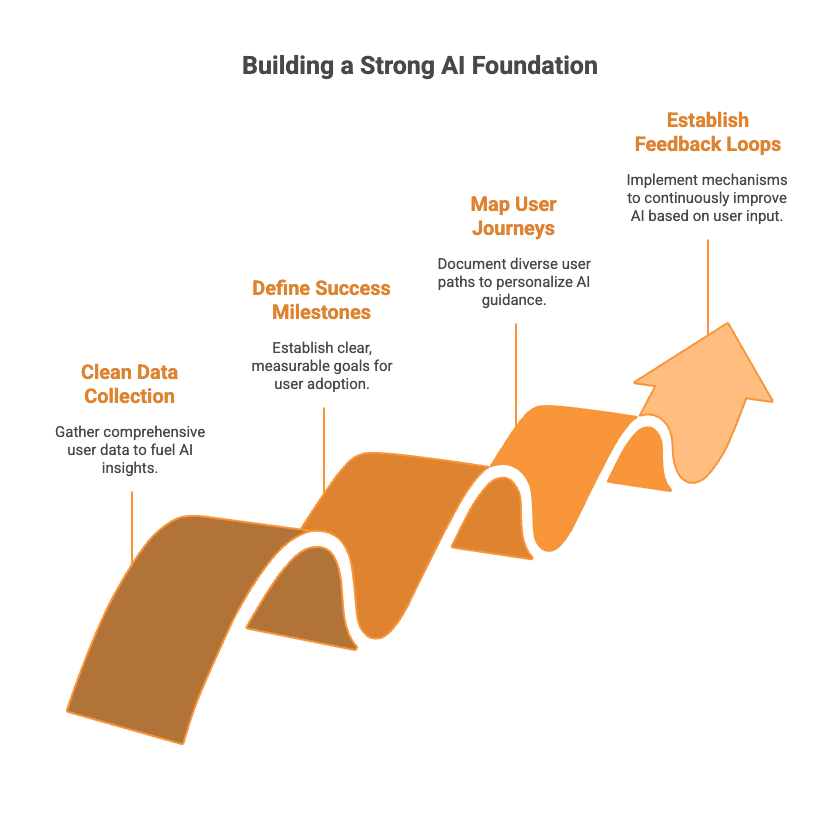
1. Clean, Comprehensive Data Collection
AI is only as smart as the data you feed it. You need to be tracking:
- User behavior signals: Clicks, hovers, scroll depth, session recordings
- Engagement metrics: Feature usage, return frequency, completion rates
- Contextual data: User role, company size, use case, technical proficiency
- Outcome data: What success looks like (e.g., created first project, invited teammates, integrated with third tool)
You also need good-quality product guidelines, such as a knowledge base, which AI can use to create personalized advice, including hints, tours, or guidance for next steps.
Most companies track only surface-level metrics. AI needs the full story. Best no-code AI based tools have already things like using sources from knowledge base or other documents, as well as event tracking for micro-interactions built-in (with some possibility of adjustment) so that you do not need to set up tracking of every button click, every form field abandoned, every tooltip dismissed.
2. Define Clear Success Milestones
What does "adopted" actually mean for your product? Be specific:
- Not just "signed up" but "completed three key workflows"
- Not just "logged in" but "achieved their first meaningful outcome"
- Not just "clicked around" but "integrated the product into their daily routine"
Create a clear adoption ladder: Activated → Engaged → Power User → Advocate. AI can't guide users to success if you haven't defined what success looks like.
3. Map the User Journey (All the Variations)
Your product has multiple user types, and each has a different path to value:
- The technical founder who wants to dive deep immediately
- The non-technical team member who needs hand-holding
- The power user migrating from a competitor
- The skeptic who's been forced to try your product by their manager
Document these journeys. What does each user type need to learn first? What are their biggest obstacles? Where do they typically get stuck? AI will use these maps to personalize, but you need to create them first.
4. Establish Feedback Loops
AI improves over time, but only if you're feeding it feedback:
- User satisfaction scores after onboarding
- Support ticket themes
- Feature request patterns
- Exit interviews with churned users
Connect these feedback sources to your AI system so it learns and adapts.
5 Powerful Ways to Use AI for Product Adoption
Now let's get tactical. Here's how you actually deploy AI to transform your product adoption.
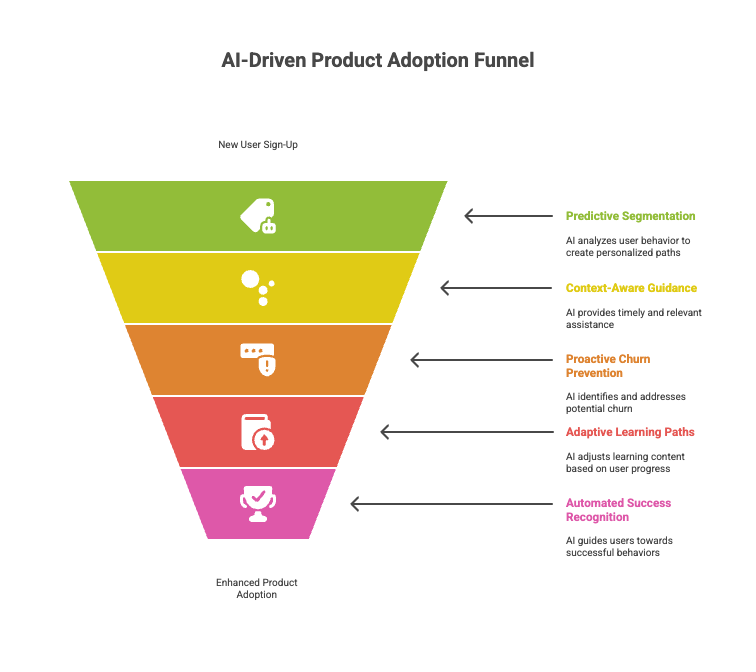
1. Predictive User Segmentation and Personalization
- The old way: You create 3-4 user segments based on company size or industry, and everyone in that segment sees the same experience.
- The AI way: Your system analyzes hundreds of signals in real-time and creates a unique adoption path for each individual user.
Here's what this looks like in practice:
Imagine two users sign up on the same day:
- User A navigates confidently, opens the advanced settings immediately, and starts exploring API documentation. AI recognizes this as a "power user" pattern and automatically offers advanced tutorials, keyboard shortcuts, and integration options.
- User B hovers over buttons for several seconds, clicks back and forth between the same two pages, and opens help documentation. AI recognizes this as a "needs guidance" pattern and activates step-by-step walkthroughs, extra tooltips, and offers a personalized onboarding call.
Same product. Completely different experiences. Both users get exactly what they need.
Implementation tip: Use AI to analyze behavioral patterns across 20+ dimensions: navigation speed, feature exploration depth, help usage, session length, time of day active, device type, and more. Cluster users dynamically, not statically.
2. Intelligent, Context-Aware Guidance
- The old way: Static tooltips that appear at predetermined moments, usually annoying users by interrupting their flow.
- The AI way: Guidance that appears exactly when the user needs it, in the format they prefer, and disappears when they don't.
Picture this: A user is trying to create their first automated workflow. They've clicked into the workflow builder, but they're not moving forward. AI notices:
- 45 seconds on the page with no action
- Mouse hovering over the "Add Trigger" button repeatedly
- Two cursor movements toward the back button
Within 3 seconds, a gentle, context-aware message appears: "Starting your first workflow? Most users begin by setting up a simple trigger. Want me to walk you through one?"
Not a generic tooltip. Not a random interruption. A timely, helpful nudge at the exact moment of hesitation.
Implementation tip: Use AI to detect "struggle signals"—repeated clicks, navigation loops, cursor movement patterns, increased time between actions. Deploy micro-interventions at these precise moments.
3. Proactive Churn Prevention
- The old way: You realize users are churning when they cancel or stop logging in. By then, it's too late.
- The AI way: You predict churn days or weeks before it happens and intervene preemptively.
Here's the scenario that keeps product leaders up at night: A user who was active for three weeks suddenly stops logging in. By the time you notice, they've already decided your product isn't worth it.
AI changes this completely. It identifies the early warning signs:
- Session frequency decreasing by 40% week-over-week
- Time spent in-app dropping from 20 minutes to 5 minutes
- Key features used in week 1 but abandoned in week 2
- Support tickets going unanswered for 48+ hours
When AI detects this pattern, it triggers automatic interventions:
- A personalized email: "We noticed you haven't used [Feature X] this week. This feature helps users like you achieve [Outcome]. Want a quick refresher?"
- An in-app message offering a quick win: "Complete this 2-minute task to see immediate results"
- A prompt to connect with a success manager for a 15-minute power session
For example, A B2B SaaS company could implement an AI churn prediction and reduce their monthly churn from 7% to 2.1% in four months. The secret? Catching users 5-7 days before they would have churned and delivering targeted interventions. Learn more about improving customer retention through better onboarding.
Implementation tip: Build a churn prediction model that scores every user daily. When scores cross critical thresholds, trigger escalating intervention sequences automatically.
4. Adaptive Learning Paths
- The old way: Everyone goes through the same onboarding sequence, regardless of how quickly they learn or what they already know.
- The AI way: The learning path adapts in real-time based on how users are actually performing.
Think about how frustrating it is to sit through a tutorial on something you already understand. Now imagine your product automatically skips the basics for users who clearly get it, and slows down for users who need more time.
Here's how it works:
A new user starts your onboarding. AI presents the first task: "Create your first project."
- If they complete it in under 30 seconds without help, AI thinks: "This user gets it. Let's accelerate." The next task is more advanced.
- If they take 3 minutes and open help documentation twice, AI thinks: "This user needs support. Let's add more scaffolding." The next task includes a video tutorial and a pre-filled template.
Every user moves at their own pace. Nobody is bored. Nobody is overwhelmed.
Implementation tip: Create modular learning content at three levels: Basic, Intermediate, Advanced. Let AI route users dynamically based on demonstrated competency. Use completion time, help usage, and success rates as signals.
5. Automated Success Pattern Recognition
- The old way: Product managers manually review data to identify what successful users do differently, then try to replicate those patterns months later.
- The AI way: The system automatically identifies success patterns and immediately guides all users toward those behaviors.
Here's where AI becomes genuinely powerful. It discovers insights you'd never find manually:
An AI system analyzing user behavior might discover:
- Users who invite a teammate within 48 hours have 6x higher retention at 90 days
- Users who complete a specific workflow combination in their first week become power users 80% of the time
- Users who engage with your product on mobile within the first 5 days have 3x longer lifetime value
Once AI identifies these patterns, it doesn't wait for a product manager to build a new onboarding flow. It immediately starts nudging new users toward these high-value behaviors:
- "Users like you see better results when they invite a colleague. Want to add a teammate now?"
- "Power users typically complete [Workflow Y] next. Should we set that up together?"
For example, let’s say you have a project management tool and you used AI to identify that users who created 3+ templates in their first week had 91% retention. You could then automatically start guiding new users to create templates early, and potentially see a 34% increase in 90-day retention.
Implementation tip: Run continuous cohort analysis with AI, comparing behaviors of retained vs. churned users. When patterns emerge with >70% confidence, automatically incorporate them into your adoption flows.
Critical Things to Keep in Mind When Using AI for Product Adoption
AI is powerful, but it's not magic. Get these wrong, and you'll create more problems than you solve.
1. Don't Let AI Feel Creepy
There's a fine line between "helpful" and "invasive." Users should feel supported, not surveilled.
- Bad: "We noticed you've been struggling with this feature for 3 minutes and 47 seconds."
- Good: "Need a hand getting started with this? Most users find a quick example helpful."
Keep AI interventions warm and human-sounding. Never reveal the full depth of tracking in user-facing messages.
2. Always Provide an Opt-Out
Some users want to explore on their own. Let them. A simple "Explore on my own" button respects autonomy and actually improves the experience for self-sufficient users.
Power users especially hate being hand-held. AI should detect this preference quickly and back off.
3. Test, Measure, Iterate
Don't assume your AI is working. Measure everything:
- Are AI-guided users adopting faster than control groups?
- Are interventions helping or annoying users?
- Which AI triggers have the highest positive response rates?
Run A/B tests continuously. What works for one user segment might fail for another.
4. Combine AI with Human Touch
AI handles scale, but humans handle complexity and emotion. Use AI for the first 80% of users, but have customer success teams ready for high-value accounts or users showing signs of serious struggle.
The perfect system: AI identifies the problem, attempts automated intervention, and if that fails, escalates to a human—with full context about what's already been tried. Learn how AI copilots can resolve support tickets efficiently while maintaining a human touch when needed.
5. Maintain Transparency
Be clear about how you're using AI. Include it in your privacy policy. If users ask, be honest: "We use AI to personalize your experience and offer help when you might be stuck."
Transparency builds trust. Hiding AI usage breeds suspicion.
6. Don't Over-Intervene
Death by a thousand tooltips is real. AI should be selective, not aggressive. Quality over quantity.
Guideline: No more than one AI intervention per session unless the user explicitly asks for more help. Let users breathe.
What Tools should you Use for AI-Powered Product Adoption
You can't build all of this from scratch. Here are the tools that make AI product adoption accessible:
1. ProductFruits
A comprehensive product adoption platform that combines AI-driven user onboarding, in-app guidance, and behavioral analytics. What sets ProductFruits apart:
- AI-powered user segmentation that creates dynamic cohorts based on behavior patterns
- Predictive prompts that appear exactly when users need guidance
- Adaptive onboarding flows that adjust based on user competency
- Built-in feedback loops that continuously improve your adoption strategy
- No-code implementation so you can deploy quickly without engineering bottlenecks
- AI Writer to create compelling in-app content and guidance
- Custom events tracking to understand user behavior at a granular level
Ideal for: SaaS companies serious about transforming their product adoption without building custom AI infrastructure. See how it compares to other no-code onboarding solutions.
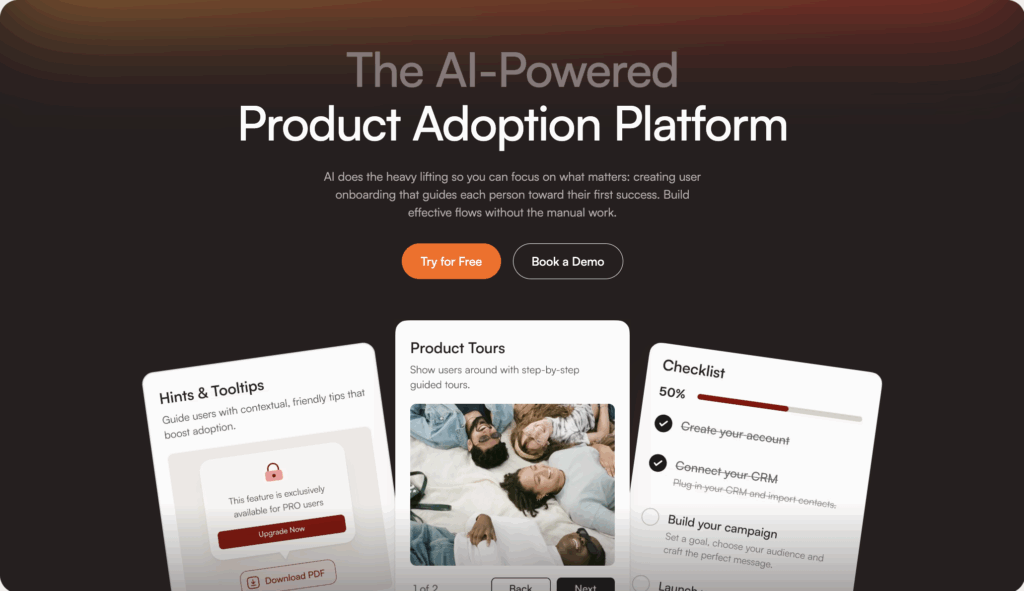
2. Pendo
Robust analytics combined with in-app guidance. Strong for large enterprises needing deep behavioral insights.
Pendo is a powerful product experience platform particularly strong in the enterprise space. Pendo's AI capabilities include:
- Sentiment analysis* that processes thousands of user feedback inputs to identify trends and urgent issues
- Behavioral AI models* that predict feature usage and recommend which features to promote to specific user segments
- Resource center* with intelligent content recommendations based on user context and behavior
- Path analysis* powered by AI to identify unexpected user journeys and friction points
- Retention analytics* that use machine learning to identify at-risk accounts before they churn
- In-app guides and walkthroughs* with sophisticated targeting based on behavioral triggers
- Product usage analytics* with AI-powered anomaly detection to spot sudden changes in engagement
Ideal for: Enterprise companies (500+ employees) with complex products, multiple user roles, and significant budget for product analytics. Particularly strong for product teams that need executive-level reporting and cross-functional adoption insights.
3. Heap
Automatic event tracking with AI-powered insights. Great for understanding what's actually happening in your product without manual tagging. Heap's unique approach includes:
- Automatic data capture* that tracks every user interaction without manual event tagging, creating a complete behavioral dataset for AI analysis
- AI-powered insights engine* that automatically surfaces significant behavioral patterns, anomalies, and opportunities
- Conversion optimization* using machine learning to identify which user paths lead to highest conversion rates
- Session replay* with intelligent filtering to focus on sessions where users struggled or churned
- Predictive audiences* that use AI to identify users likely to convert, expand, or churn based on behavioral signals
- Smart data governance* that automatically categorizes and organizes events for clean analysis
- Integration capabilities* that feed behavioral data to other AI systems in your stack
Ideal for: Data-driven product teams that want comprehensive behavioral data without engineering overhead. Particularly valuable for companies doing frequent A/B testing or those with complex user journeys that are hard to predict upfront. Best suited for companies with strong analytics capabilities that can act on insights.

4. Amplitude
Amplitude is a sophisticated product analytics platform with deep AI integration for understanding and improving user engagement:
- Predictive analytics* that forecast user behavior, lifetime value, and churn probability weeks or months in advance
- AI-powered recommendations* that suggest which features to build, improve, or sunset based on impact analysis
- Behavioral cohorts* automatically created by machine learning to group users by engagement patterns rather than demographics
- Experiment results analysis* with AI-driven statistical significance testing and impact prediction
- Anomaly detection* that alerts you to unusual patterns in real-time (sudden drop-offs, unexpected feature usage spikes)
- Journey mapping* that uses AI to identify optimal paths to conversion and common failure points
- Data quality monitoring* with machine learning to catch instrumentation errors before they corrupt analysis
- Cross-platform analytics* that uses AI to stitch together user identity across web, mobile, and other touchpoints
Ideal for: Growth teams at scale-ups and enterprises that need sophisticated analytics to drive product decisions. Best for companies with dedicated analytics or data science resources who can build adoption strategies on top of the insights. Particularly strong for mobile-first products and companies with complex conversion funnels.
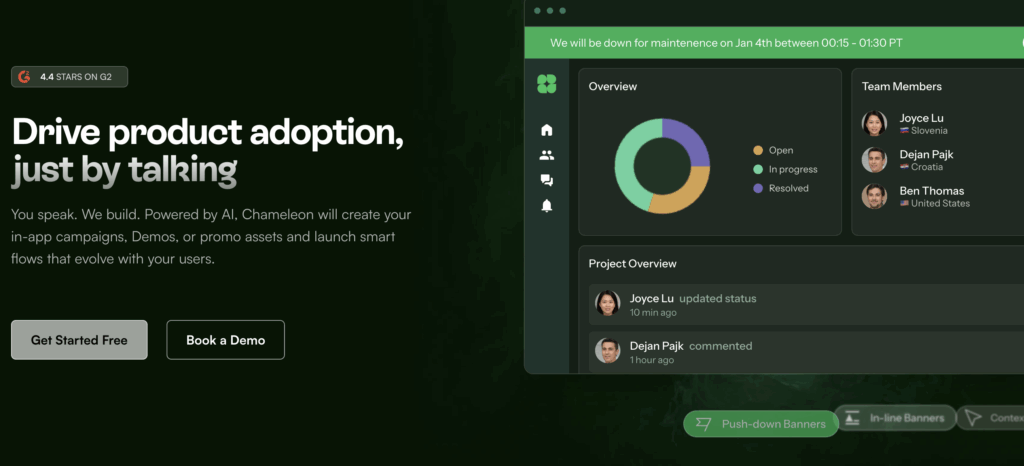
5. Chameleon
User onboarding flows with personalization capabilities. Good for creating targeted experiences. and is a focused user onboarding and product adoption platform with growing AI capabilities:
- Smart targeting* that uses behavioral triggers and AI-based user scoring to show the right message at the right time
- A/B testing engine* with machine learning recommendations for which onboarding variations will perform best
- Engagement scoring* that automatically identifies which users need more help vs. those ready for advanced features
- Personalization rules* that can be AI-assisted to create dynamic experiences based on user characteristics and behavior
- Tour analytics* with intelligent insights about where users drop off or struggle in your onboarding flows
- Rate limiting and frequency capping* with smart algorithms to prevent tooltip fatigue
- Microsurveys and NPS* with sentiment analysis to understand user emotions at key moments
Ideal for: SaaS companies focused specifically on improving onboarding and in-app guidance. Works particularly well for product-led growth companies that need sophisticated onboarding flows without a large engineering team. Best suited for B2B SaaS with relatively straightforward products where excellent onboarding is the primary growth lever.
Choosing the Right Tool: Need help deciding? Check out our comprehensive guides on the best product tour software and best SaaS onboarding software for 2025.
Results You Can Expect from AI-Powered Product Adoption
Let's talk real numbers. What actually happens when you implement AI for product adoption?
1. Faster Time-to-Value
You can expect to see a 40-60% reduction in time from sign-up to first meaningful outcome.
A user who previously took 5 days to achieve their first win now does it in 2 days. This matters enormously—users who see value faster stick around.
2. Higher Feature Adoption Rates
Typical result: 3-4x increase in adoption of new features.
Instead of 10% of users trying your new feature, 35-40% do. Your development efforts actually reach users.
3. Reduced Churn
Typical result: 30-50% reduction in early-stage churn (first 90 days).
The users who would have quietly disappeared now stick around because AI caught them before they left.
4. Lower Support Costs
Typical result: 25-40% reduction in support ticket volume.
When users get proactive help, they don't need to submit tickets. Your support team shifts from reactive firefighting to proactive success management.
5. Increased Customer Lifetime Value
Typical result: 50-80% increase in LTV over 12 months.
Users who adopt features properly become power users. Power users expand usage, upgrade plans, and stick around longer.
6. Better Product Insights
Bonus result: You discover patterns you never would have found manually.
AI reveals which feature combinations drive retention, which user paths lead to churn, and which moments matter most. These insights inform your entire product roadmap.
Getting Started: Your AI Product Adoption Action Plan
You're convinced. Now what? Here's your step-by-step plan:
Week 1: Audit and Plan*
- Map your current user journey and identify drop-off points
- Define what "success" looks like for your product (clear milestones)
- Review your current data collection (Are you tracking enough signals?)
- Identify your highest-priority adoption problems
Week 2: Choose Your Tools*
- Evaluate AI product adoption platforms
- Ensure technical requirements are met (integration capabilities, data access)
- Get stakeholder buy-in (show them the churn and adoption data)
- Compare digital adoption platforms to understand the benefits for your business
Week 3-4: Implement Foundation*
- Set up tracking for behavioral signals (if not already in place)
- Integrate your chosen AI adoption platform
- Configure initial user segments and success milestones
- Create baseline measurements for comparison
Week 5-8: Build and Test*
- Create personalized onboarding flows for your top 2-3 user types
- Set up AI-driven interventions for key drop-off points
- Implement churn prediction and prevention workflows
- Run small-scale A/B tests to validate effectiveness
- Explore no-code onboarding solutions to speed up implementation
Week 9-12: Scale and Optimize*
- Roll out AI adoption features to all users
- Monitor metrics obsessively (adoption rates, time-to-value, churn)
- Iterate based on user feedback and AI insights
- Train your team on interpreting and acting on AI recommendations
Ongoing: Continuous Improvement*
- Review AI performance monthly (What's working? What's not?)
- Expand AI to more adoption touchpoints (email, mobile, support)
- Share wins with stakeholders (show the ROI clearly)
- Stay current on AI capabilities (this field moves fast)
- Learn from others' success stories and implementation strategies
The Bottom Line: Adapt or Get Left Behind
Here's the uncomfortable truth: Product adoption is no longer a nice-to-have. It's existential.
Your users have zero patience. Your competitors are using AI. The bar for "good enough" onboarding just got 10x higher.
But here's the good news: You don't need a PhD in machine learning or a six-figure AI budget. The tools exist today. Companies of all sizes are implementing AI product adoption and seeing transformational results.
The question isn't whether you should use AI for product adoption. The question is: Can you afford not to?
Every day you wait, users churn who didn't have to. Features go unadopted that could have succeeded. Revenue walks out the door because users "didn't get it."
Start small. Pick one high-impact use case—maybe predictive churn prevention, or personalized onboarding. Implement it. Measure the results. Then expand.
A year from now, you'll look back at this moment as the turning point—when you stopped guessing about what users need and started knowing. When you stopped reacting to churn and started preventing it. When you stopped building products users struggle with and started building products users can't live without.
If you're serious about using AI to drive product adoption, ProductFruits provides the complete platform to make it happen—without requiring a data science team or months of custom development.
See how AI can transform your product adoption in days, not months. Learn more about how digital adoption platforms benefit businesses and explore the best product tour software options for your needs.


Weekly newsletter
Get the latest releases, tips, articles, and exclusive interviews delivered to your inbox weekly—no spam!