How Product Fruits Compares to Other No‑Code Onboarding Solutions for User Activation in 2025


Let’s call out the reflex that still haunts too many teams: shipping a product tour and calling it “onboarding.” In 2025, that’s table stakes. Activation is the new growth mandate — the precise moment a user first feels your core value. Hit it early and you buy retention, expansion, and reputation. Miss it and your CAC quietly lights itself on fire. What you need is the right No‑Code Onboarding solution.
https://vimeo.com/1127445241?share=copy&fl=sv&fe=ci
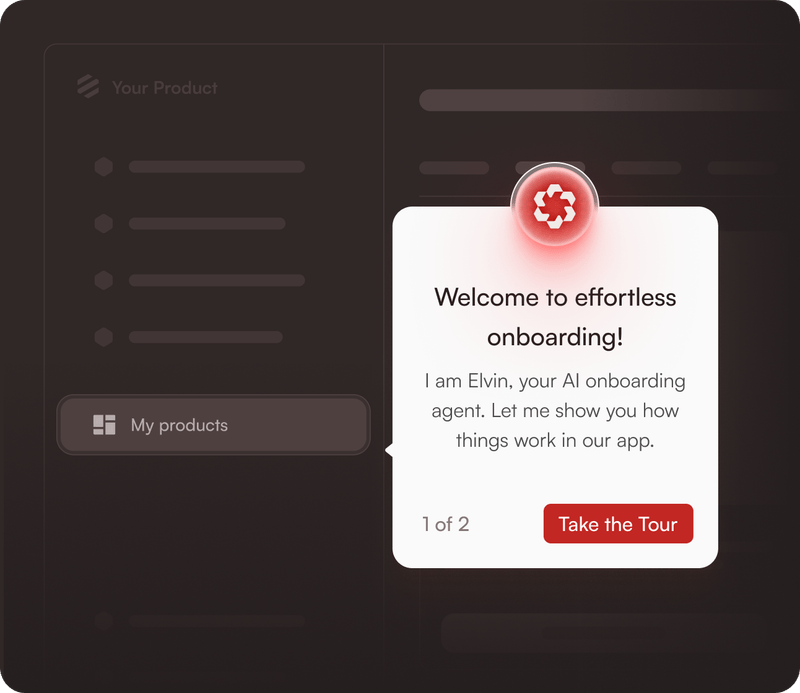
Product Fruits has just launched its new generation onboarding with Elvin AI. Watch our keynote!
Why did activation get harder and more important? Because two curves crossed:
- Capability curve: Teams ship broader, denser products — more integrations, more roles, more surface area.
- Patience curve: Users expect instant clarity. Not eventually. Now.
The answer isn’t “less friction.” It’s earned friction - timely, contextual guidance that adapts to what each user is trying to do. That’s where AI finally matters. Automation and personalization have converged into something practical: onboarding that reacts in real time, without a 40‑step rule engine maintained by a single heroic PMM.
This guide is a practitioner’s comparison of Product Fruits with seven familiar names: Pendo, Whatfix, Chameleon, Userpilot, Appcues, Userflow(s), and UserGuiding. We’ll keep it simple: what each does well, where it bites back, and when Product Fruits is the better choice (and when it isn’t).
TL;DR
- User Activation is the growth mandate in 2025. Users expect instant clarity while products get denser. The winner is guidance that adapts in real time.
- Product Fruits is a no‑code, AI‑assisted product adoption platform that unifies tours, tooltips, checklists, announcements, in‑app surveys (NPS/CSAT/CES), and a built‑in knowledge base with deep styling and MAU‑based pricing.
- Choose Pendo for enterprise analytics + governance, Whatfix for training/LMS, Chameleon for pixel‑precise UI control, Userpilot for web‑first analytics + experiments, Appcues for quick wins, Userflow for tidy checklists/resource centers, UserGuiding for budget‑friendly starts.
- Pick Product Fruits when you want speed, AI personalization, consolidation (surveys + KB), and predictable pricing for web‑first SaaS.
How Product Fruits helps you create user onboarding flows for user activation without any code.
Product Fruits is an AI‑powered product adoption platform that lets non‑technical teams build and iterate onboarding without engineering. You can design tours, tooltips, hints, checklists, announcements, a built‑in knowledge base, and in‑app surveys, then personalize all of it in real time.
- Move fast: Truly no‑code builder. Launch in hours, not sprints.
- Personalize with AI: Adaptive sequencing nudges each user toward the next best action.
- Close the loop: NPS/CSAT/CES and custom surveys are tied to journeys and branching logic.
- Unify help: Knowledge base + in‑app launcher (“life ring”) reduce support drag.
- Stay on brand: Deep styling and optional custom CSS without developer debt.
- Iterate weekly: Responsive support and low‑latency changes.
- Plan with confidence: Transparent, MAU‑based pricing.
Your form isn’t your growth engine. Your product experience is. And Product Fruits helps you build a world-class product experience.
How do you choose which user onboarding platform to use for your user activation?
- AI‑assisted orchestration is usable. It’s not a toy anymore. Real‑time personalization has moved from “nice demo” to measurable lift.
- Consolidation beats Frankenstein stacks. Tours in one tool, surveys in another, docs in a third = slower iteration and fragmented data.
- Governance matters earlier. As more teams ship more guidance, guardrails for targeting, visibility, and analytics become non‑negotiable.
- Pricing predictability wins deals. Opaque quotes stall momentum. MAU‑based tiers with clear limits keep finance onside.
Choose a platform that makes it easy to design, aim, learn, and adapt — fast.
1) How Product Fruits compares to Pendo:
Here, we will take a look at how Product Fruits compares to Pendo. Here’s the TLDR:
TL;DR — When to Use Pendo vs. Product Fruits
Use Pendo if your organization needs deep analytics, enterprise-wide governance, and AI‑assisted onboarding at scale. It’s ideal for large teams managing multiple products where advanced event tracking, segmentation, and reporting drive strategic insights — but it requires data maturity, training, and bigger budgets.
Choose Product Fruits if you want a lightweight, all‑in‑one onboarding suite that includes tours, surveys, tooltips, announcements, and a native knowledge base. It’s built for smaller or agile SaaS teams that value speed, simplicity, and transparent MAU‑based pricing. Product Fruits gets you from signup to in‑app guidance in hours, while Pendo shines when analytics depth and enterprise governance are top priorities
What are the pros of using Pendo as a user onboarding and user activation tool?
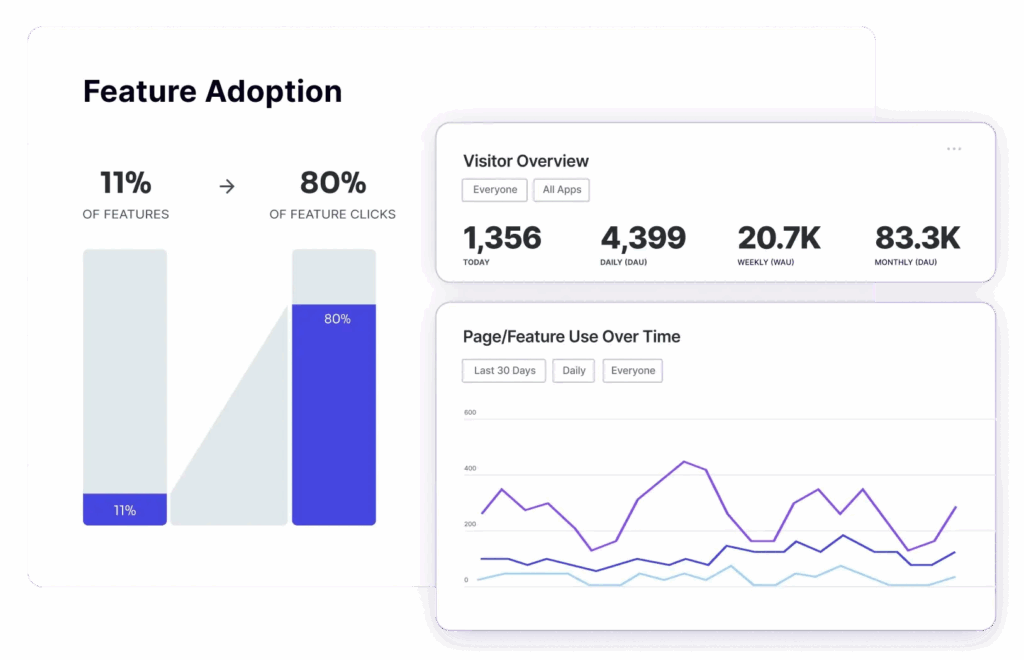
1. Pendo has Deep, Retroactive Product Analytics
Pendo captures event-level user data retroactively from the moment it’s installed — even if goals or events weren’t predefined. This means you can uncover detailed insights into user journeys, feature adoption, and engagement trends without heavy upfront setup. Ideal for answering complex retention and usage questions with minimal data prep.
2. Pendo gives Advanced Segmentation and Enterprise Governance
Built for scale, Pendo enables granular user segmentation by behavior, demographics, and feedback. Its governance controls allow multiple teams to collaborate safely across products, while org-wide dashboards align stakeholders on activation and adoption KPIs. Perfect for large teams managing multiple onboarding and analytics streams.

- Pendo has Cross-Platform In-App Guidance (Web + Mobile)
Pendo’s in-app guidance works across web and native mobile apps, giving teams a unified onboarding approach. The no-code builder uses templates and drag-and-drop editing to simplify creation, while AI-assisted guide generation recommends optimal flows and copy based on user behavior — reducing manual effort and accelerating activation cycles.
TL;DR: Pendo excels when enterprise analytics, scalable governance, and AI-assisted onboarding matter most.

What are the cons of using Pendo as a user onboarding and user activation tool?
1. Pendo Requires product analytics maturity and onboarding team enablement - To fully leverage Pendo’s advanced analytics and segmentation, teams often need a decent level of product analytics maturity and expertise in data interpretation. Onboarding teams may require training or enablement to build and maintain effective data-driven onboarding flows, which can initially slow adoption and reduce short-term impact.
2. Pendo has No native knowledge base, reliant on integrations - Pendo does not provide a built-in knowledge base solution. Customers must integrate external knowledge base platforms, leading to managing and maintaining two separate systems. This can complicate analytics reconciliation and create fragmented user support experiences requiring additional coordination.
3. Pendo has Custom pricing with potential opacity and premium costs - Pendo’s pricing and packaging are customized based on company size, user volume, and feature needs, often requiring early stakeholder alignment to approve budgets. Pricing is not transparent upfront and can involve premium quotes for enterprise-level features, which may stall procurement or lead to over-investment for smaller teams.

4. Pendo’s Complexity can be a barrier for lean teams - Given Pendo’s comprehensive feature set designed for enterprise-scale usage, some startups or smaller product teams may find the platform overwhelming or too complex for rapid onboarding needs, with longer setup and adjustment periods.
Why Product Fruits is the better Pendo alternative
1. Product Fruits is simple and lightweight - With Product Fruits, you get a single, lightweight platform to handle onboarding tours, feature announcements, surveys, in‑app tooltips, and a searchable knowledge base without stitching together multiple tools. Your PM, PMM, or CS lead can update it weekly without engineering sprints.
2. ProductFruits has simple transparent pricing - You get predictable, transparent MAU‑based pricing that scales cleanly with your user base — and want to avoid long enterprise procurement cycles, custom quote negotiations, or the uncertainty of hidden fees.

3. ProductFruits helps you iterate faster - If you value rapid iteration and ease‑of‑use over an exhaustive product analytics stack. Product Fruits gives you actionable, AI‑assisted "next best action" recommendations without requiring months of tagging and event mapping.
4. ProductFruits helps you ship faster because of its easy learning curve - Your onboarding team needs to start creating guides and tours within hours of sign‑up, not after a lengthy enablement and training program. With Product Fruits, the learning curve is minimal, and non‑technical teams can own the workflow end‑to‑end.
5. ProductFruits works for both desktop web and mobile web - You operate on both desktop and mobile but prioritize speed over deep customization. Product Fruits delivers consistent in‑app guidance experiences without demanding deep internal dev resources.
6. ProductFruits focuses on user activation that drives lifetime revenue - Your product’s success depends more on guiding new users and collecting direct feedback than on complex segmentation reports or historical analytics. Product Fruits was designed for user activation, not just analysis.
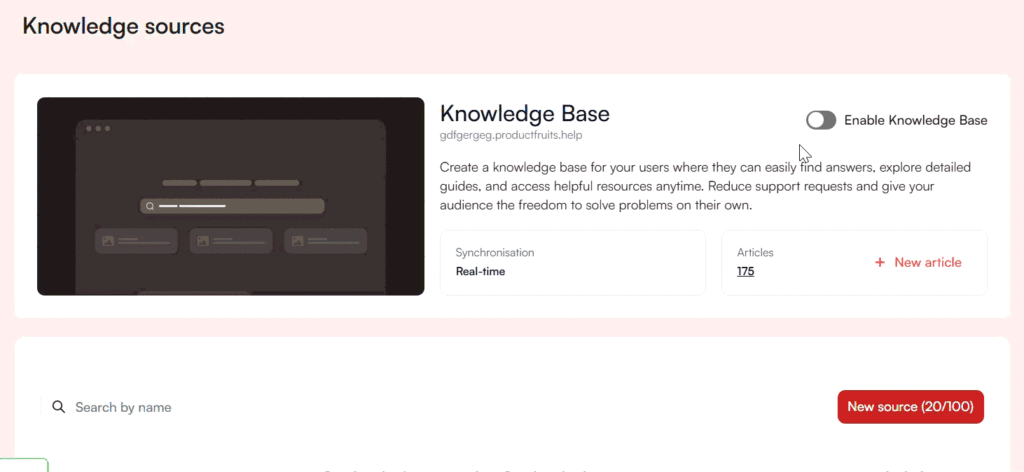
7. ProductFruits has an in-built knowledge base: Product Fruits keeps your knowledge base native to your onboarding tool so analytics, updates, and content all live in one ecosystem — no need to sync, reconcile, or maintain a separate KB platform.
8. Product Fruits has low time-to-value to get the ball rolling - You care about time‑to‑value: Product Fruits can deliver a fully functional onboarding experience in days, whereas enterprise‑scale platforms like Pendo can take weeks or months to configure.
“For a product like FLOWN, highly personalized in-app communication with our users is crucial to our success. By delivering the right messages and content at the right time to the right users, we’ve significantly enhanced engagement and improved product adoption. Product Fruits has also reduced time to value for new users, helping them quickly recognize the benefits of our platform” - Guy Brockless, Product & Strategy.
Here is a clear side-by-side comparison table for Product Fruits vs Pendo, highlighting feature, value, and usage differences relevant to onboarding and product adoption scenarios.
Feature/AspectProduct FruitsPendoOnboarding Tours/GuidesInteractive, AI-powered, all native, rapid setupInteractive, web & mobile, retroactive analyticsKnowledge BaseBuilt-in, native, linked to tours and helpIntegration required, not nativeSurveys & FeedbackBuilt-in NPS/surveys, easy targetingNPS, CSAT, custom—often upgrade/add-onPricingTransparent MAU-based, starts ~$129/monthOpaque, seat- and enterprise-tier, premium pricing, extra for add-onsCustomizationAdvanced CSS, fonts, colors, brandingLimited branding optionsNo-code Content CreationYes—PMs/marketers can use without engineersYes, but analytics and segmentation setup steeperEvent AnalyticsLightweight, basic insights, guided actionsDeep, event-level, segmentable, retroactive, exportableAI AssistanceAI “next best action,” auto-content optimizationAI for guide creation and analytics, more complexIn-app CommunicationAnnouncements, surveys, release notes all nativeIn-app guides, less immediate messagingEase of UseQuick setup, dedicated CSMSteep learning curve, enablement needed.Value for MoneyNo hidden feesPremium pricing often cited as barrierCustomer SupportDedicated onboarding and migration helpReliable for enterprise, less for smaller teams
Decision rule: If your top constraint is time and focus, pick Product Fruits. If it’s analytics depth + governance at enterprise scale, pick Pendo.
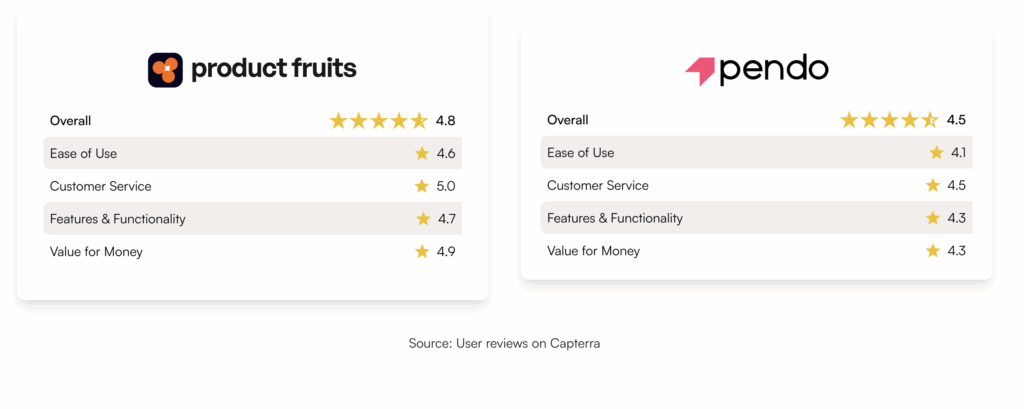
Check out how Product Fruits compares against Pendo in more depth here
2) How Product Fruits compares to Whatfix:
What are the pros of using Whatfix as a user onboarding and user activation tool?
1. Whatfix supports SCORM/xAPI exports for compliance and training
Whatfix enables organizations to export onboarding and training content in SCORM and xAPI formats, fully compatible with most Learning Management Systems (LMS). This makes it the go-to solution for industries and enterprises with strict compliance standards, or those needing to deliver structured, trackable training programs at scale.

2. Whatfix empowers large-scale, multi-language onboarding rollouts
With automatic translation into 70+ languages, Whatfix lets global organizations create consistent onboarding and activation experiences across regions. Teams can deploy content to internal staff or customers worldwide, all without duplicating flows or manually recreating content in every language.
3. Whatfix excels at enterprise change management and complex workflows
Its robust platform supports not just customer onboarding, but also internal employee onboarding and enterprise-wide change management. Whatfix streamlines the adoption of complex software stacks, policies, or new tools—ensuring users quickly master multi-step workflows and reducing friction during organizational change.
4. Whatfix provides a no-code visual editor with extensive UI widgets
Any non-technical team member can use Whatfix’s intuitive drag-and-drop WYSIWYG builder to create personalized, branded onboarding guides. With extensive UI widgets like tours, flows, pop-ups, task lists, and smart tips, it’s easy to deliver in-app guidance that matches both product design and user context.

What are the cons of using Whatfix as a user onboarding and user activation tool?
1. Heavier implementation and ongoing maintenance
Whatfix’s enterprise-grade features require extensive setup, often involving professional services and ongoing IT participation. This can drain resources and slow time-to-value for smaller or lean teams who need rapid onboarding solutions.
2. Custom pricing with growing Total Cost of Ownership (TCO)
Pricing for Whatfix is based on user volume, features, and service agreements—so costs can quickly climb, especially as businesses expand usage to include multiple languages, analytics, and LMS exports. Budgeting can be unpredictable for teams with evolving needs.

3. Overkill for simple onboarding needs
Smaller SaaS companies or products focused on fast, straightforward onboarding may find Whatfix’s broad capabilities and complexity excessive, resulting in inefficiencies and unnecessary costs when training-grade content or LMS integrations aren’t needed.
4. Less agility for fast iteration
Whatfix’s comprehensive governance and enterprise focus make it less nimble than platforms like Product Fruits or Userpilot. Teams may experience slower onboarding content updates and longer timeframes to roll out new experiences.
5. Complex UI and learning curve
While powerful, Whatfix’s feature-rich interface demands dedicated onboarding specialists or IT resources. Teams without specialized support may struggle with setup, customization, and fully leveraging the platform’s capabilities.
Why Product Fruits is the better Whatfix alternative
Product Fruits excels when your onboarding strategy needs to be fast, flexible, and highly accessible for small-to-mid SaaS teams, while Whatfix is a powerhouse for enterprise organizations needing formal training workflows and compliance-ready exports.
- Self-serve onboarding with rapid iteration
Product Fruits lets your non-technical PMs, marketers, or support leads create, launch, and adjust onboarding flows, checklists, and help content weekly—no engineering or professional services needed. Whatfix often requires heavy initial implementation and ongoing services support.
- Self-serve onboarding with rapid iteration
Product Fruits lets your non-technical PMs, marketers, or support leads create, launch, and adjust onboarding flows, checklists, and help content weekly—no engineering or professional services needed. Whatfix often requires heavy initial implementation and ongoing services support.
- Affordability and transparent pricing:
Product Fruits offers straightforward, usage-based pricing (monthly active users), making budgeting and stakeholder buy-in simple. Whatfix has opaque custom pricing that can rise quickly with expanded scope, add-ons, or analytics modules.
- Native, built-in surveys and knowledge base:
You can ship in-app surveys, NPS, and a contextual knowledge base directly inside Product Fruits. This helps you reduce support tickets and iterate on onboarding content—no need for external integrations as required in Whatfix.


Weekly newsletter
Get the latest releases, tips, articles, and exclusive interviews delivered to your inbox weekly—no spam!